How to Measure AI Visibility: 6-Step Guide With Real Data
Measure AI visibility in six steps: questions, engines, mentions and citations, share of voice, and the activities that track it. Real data included.


Updated November 11, 2026
In this article
What you need to measure AI visibility
Which metrics measure AI visibility
Step 1: Write the questions your buyers ask
Step 2: Ask each engine with web search on
Show More
AI visibility is how often an AI engine names your brand when a buyer asks a question you want to be the answer to. To measure it, write a fixed set of buyer questions, ask each AI engine, record mentions and own-site citations, calculate raw and weighted share of voice, test which activities line up with own-site citations, and repeat every month.
This guide walks through the six steps with a real measurement for Babysense, a baby monitor maker and a Footprint customer that agreed to publish its numbers. In one measurement, one brand had three different readings: 6.4% of 267 brand mentions on ChatGPT, 14.6% of 481 brand mentions in Google AI Overviews, and 1.3% on ChatGPT when the questions are weighted by search volume.
Key takeaways
- Measure AI visibility as share of voice: your brand's mentions divided by all tracked brands' mentions, on one engine, across a fixed set of buyer questions.
- Measure more than one engine. Babysense had 6.4% of 267 ChatGPT mentions and 14.6% of 481 Google AI Overviews mentions on the same day.
- Report weighted share beside raw: one keyword carries 60% of the 135 keywords' monthly searches, and Babysense's 1.3% weighted share suggests ChatGPT's answer to it left the brand out.
- Count own-site citations: mentions with a source link to the brand's own site. Nanit drew 36 of ChatGPT's 107; Babysense drew 6.
- Test activities against own-site citation share on ChatGPT. Review-page presence scored +71; new quality links scored +10.
The six steps at a glance:
- Write the questions your buyers ask.
- Ask each engine with web search on.
- Record every mention and every own-site citation.
- Calculate raw and weighted share of voice.
- Test which activities track own-site citations.
- Measure again on the same question set.
What you need to measure AI visibility
You need a keyword list, a competitor list and a few hours. The reason to bother: in vendor research by G2, a software review site, 51% of 1,076 B2B software decision makers said they begin research with an AI chatbot more often than with Google (G2, The Answer Economy, vendor survey). Buyers of consumer products such as baby monitors may behave differently, which is why you measure your own market.
- A keyword list for your market, with monthly search volume for each keyword. Your SEO tool's export works.
- A competitor list: the brands a buyer might choose instead of you, with their website domains. Babysense tracks 18, itself included.
- Access to the engines, ideally through their APIs with web search turned on, so the answers draw on current web pages. For a quick first read, the free AI visibility checker shows how ChatGPT and Gemini treat your brand today.
- Time: an estimate of half a day for a first reading of 20 to 30 questions on one engine.
- Difficulty: beginner for most steps; testing activities needs basic statistics.
New to the terms? What generative engine optimization (GEO) is explains the discipline this measurement serves.
Which metrics measure AI visibility
Five metrics cover most of what a team reports. State the basis next to each one, or the number can't be checked.
Metric | What it counts | Basis to state |
|---|---|---|
Mention rate | Answers that name your brand, divided by answers asked | Question count, engine, date |
Share of voice | Your mentions divided by all tracked brands' mentions | Mention count, engine, date |
Weighted share of voice | Share of voice with each question counted by its keyword's monthly searches | Keyword volumes and their source |
Own-site citation share | Mentions with a source link to your site, divided by all brands' such mentions | Citation count, engine, date |
Position and stance | Where in the answer you appear, and whether the mention is positive or negative | How you coded it |
The numbers in this guide use mentions, share of voice, weighted share of voice and own-site citations. They don't use position or stance. Visits that reach your site from AI engines show up in your web analytics, a separate signal this guide doesn't measure.
Step 1: Write the questions your buyers ask
By the end of this step you have a fixed list of buyer questions to reuse every month. Every number that follows is calculated over this list.
- Start from your keyword list. Babysense's 135 questions came from 135 keywords, from "best baby monitors" to "baby monitor with breathing sensor".
- Rewrite each keyword the way a buyer would ask a chatbot. "Long range baby monitor" becomes a question from a new parent who wants to hear the baby from a detached garage.
- Tag each question with its intent (researching, comparing, ready to buy), and keep questions that name your brand in a separate group, because they inflate your share.
- Write in your market's language and set the country. Babysense's measurement runs in the United States.
The free prompt generator writes a first list from a website. As a rule of thumb of ours, 20 to 30 questions give a first reading. To check the list, read it aloud to a salesperson: every question should sound like something a buyer said.
Step 2: Ask each engine with web search on
Ask every question on each engine with web search turned on, and store the answer, the date and the country.
Which engines to ask
- ChatGPT. Footprint asks it through OpenAI's API with the web search tool turned on, which lets the model search the internet and attach source links (OpenAI, web search guide). The ChatGPT window and the API with web search on can give different answers, so keep to one method. See how Footprint measures ChatGPT.
- [Gemini](https://thefootprint.ai/platform/engines/gemini), [Claude](https://thefootprint.ai/platform/engines/claude) and [Perplexity](https://thefootprint.ai/platform/engines/perplexity). They can be asked the same way, through their APIs.
- Google AI Overviews. They are read from Google's results page, and Google shows them only when its systems judge them useful (Google Search Central). See how Footprint reads Google AI Overviews.
ChatGPT answered each Babysense question once. If you can afford it, ask each question several times and count a brand once per question rather than once per run. That is our recommendation; this measurement didn't do it.
How much AI engines disagree on your brand
For Babysense, ChatGPT answered the 135 questions. Google was searched once for each keyword and once for each question (270 searches), and 243 of those showed an AI Overview. The two engines' bases differ: Babysense had 6.4% of 267 ChatGPT mentions and 14.6% of 481 AI Overview mentions (70 of them).
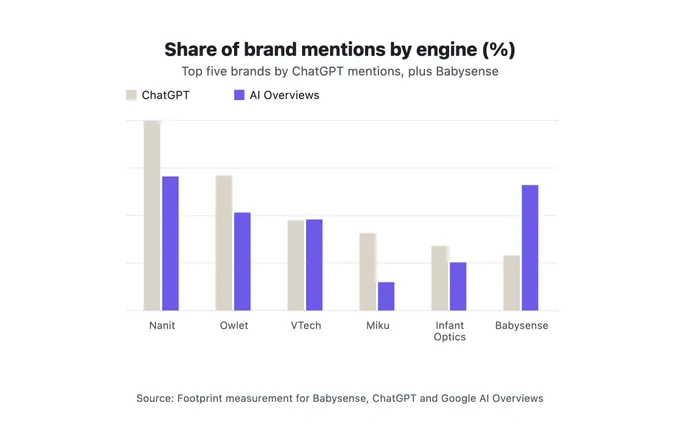
Brand | ChatGPT share | AI Overviews share |
|---|---|---|
Nanit | 22.1% | 15.6% |
Owlet | 15.7% | 11.4% |
VTech | 10.5% | 10.6% |
Miku | 9.0% | 3.3% |
Infant Optics | 7.5% | 5.6% |
Babysense | 6.4% | 14.6% |
Babysense ranked seventh on ChatGPT and second in AI Overviews. Momcozy split more sharply: 2 of ChatGPT's 267 mentions (0.7%) against 48 of AI Overviews' 481 (10.0%). Two mentions is a small base, so read that gap as a prompt to look closer.
Step 3: Record every mention and every own-site citation
Turn each answer into a row of data, with one row per brand named.
- Count a mention each time a brand is named. Detect tracked competitors by name and domain, and log other brand names too. ChatGPT named 16 of Babysense's 18 tracked brands.
- Mark a mention as cited when a source link sits in the same passage of the answer. The link can go to the brand's site or to a third-party page.
- Flag own-site citations: cited mentions whose link points to the brand's own domain. Footprint counts these, and they are the citation figures in this guide.
A spreadsheet with these columns is enough to start:
Question | Engine | Date | Brand | Position in answer | Linked to own site? | Linked domain |
|---|---|---|---|---|---|---|
Best baby monitor for a detached garage? | ChatGPT | Your run date | Brand A | Second in a list | Yes | brand-a.com |
What own-site citations show about a brand
The cited share varies widely. eufy (Anker) had its own site linked in 15 of its 19 ChatGPT mentions, while Angelcare had none in 9.
Babysense's own site was linked in 6 of its 17 mentions. A high cited share suggests the engine found the brand's own pages while searching, which could mean pages that answer buyer questions directly are worth strengthening. A brand named without a link may be named from other sources, such as review lists or the model's training data. The data can't tell which.
Step 4: Calculate raw and weighted share of voice
Share of voice is your brand's mentions divided by all tracked brands' mentions, on one engine, across one fixed question set. Report it raw and weighted by search volume, and always give the mention count, question count, engine and date. Footprint's AI share of voice page covers the method.
Raw share of voice
Raw share of voice counts every question equally: a brand's mentions divided by all tracked brands' mentions on that engine. Babysense had 17 of 267 ChatGPT mentions, 6.4%. A figure like that can be checked; a bare percentage can't.
Nanit led with 22.1% of the total (table below). Babysense had 17 mentions. Three more would have put it past eufy, and four more past Infant Optics.
Weighted share of voice
Weighted share of voice counts each question by the monthly search volume of its keyword, so a mention on a heavily searched question counts for more. The 135 keywords add up to 183,080 monthly searches, and "best baby monitors" is 110,000 of them, or 60%. A brand named in the answer to that one question gets a large part of the weight.
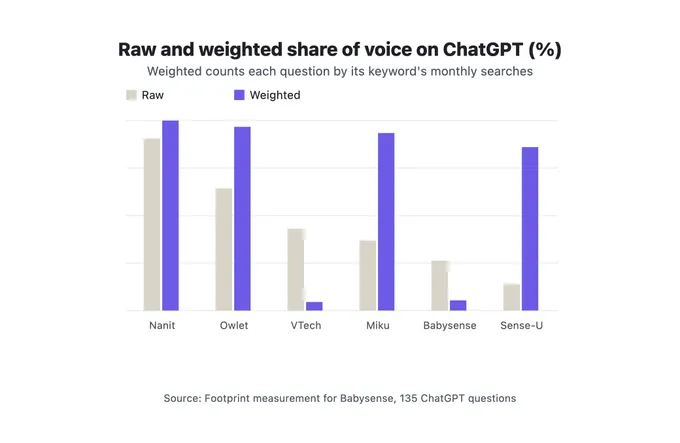
Nanit, Owlet, Miku and Sense-U each have a weighted share above 20% (21.0% to 24.4%), which suggests ChatGPT's answer to that question named all four. Sense-U got there with 9 mentions, so weighting can lift a small brand. Babysense (1.3%), VTech (1.1%), Infant Optics (1.0%) and eufy (0.8%) sit near 1%, which suggests that answer left them out.
The same gap appears in Google AI Overviews: Babysense had 14.6% raw and 3.5% weighted. Report both figures: weighted share shows where the heavily searched questions are lost, and raw share shows breadth across all 135 questions.
Brand | ChatGPT mentions | Questions naming brand | Raw share | Weighted share | Own site cited |
|---|---|---|---|---|---|
Nanit | 59 | 48 | 22.1% | 24.4% | 36 |
Owlet | 42 | 37 | 15.7% | 23.6% | 7 |
VTech | 28 | 28 | 10.5% | 1.1% | 5 |
Miku | 24 | 21 | 9.0% | 22.8% | 8 |
Infant Optics | 20 | 19 | 7.5% | 1.0% | 9 |
eufy (Anker) | 19 | 16 | 7.1% | 0.8% | 15 |
Babysense | 17 | 17 | 6.4% | 1.3% | 6 |
Sense-U | 9 | 9 | 3.4% | 21.0% | 4 |
The table shows the seven brands with the most ChatGPT mentions, plus Sense-U for its weighted share. Ten other tracked brands, two of them never named, share the remaining 49 mentions.
"Questions naming brand" divided by questions asked is the mention rate, a figure you can compute without search volumes. Babysense appeared in the answers to 17 of 135 questions (13%), Nanit in 48 (36%). Nanit's 59 mentions in 48 answers show that mentions can exceed questions when one answer names a brand more than once. For the full story behind these figures, read Babysense's share of voice results.
Step 5: Test which activities track own-site citations
In short: list the public activities each brand does, then check which of them line up with the brands that get cited most.
Which activities to count
For every tracked brand, count what a buyer and a search engine can see: mentions in Google's results by page type, Reddit posts and upvotes, YouTube videos and their engagement, links to the brand's site, and the brand's own pages. Babysense's measurement counted 46 activities for 18 brands. See how the activities are measured.
What to test activities against
Footprint tests activities against own-site citation share: a brand's own-site citations divided by all brands' own-site citations on ChatGPT. We chose it because it is the part of an answer that hands a buyer a link to the brand. Mention share wasn't the target, so a correlation here describes citations, not mentions. ChatGPT's answers carried 107 own-site citations in all. Nanit had 36 of them (33.6%) and Babysense 6 (5.6%).
How to test activities with a correlation
Rank the brands on each activity and on own-site citation share, and compute a Spearman rank correlation, reported on a scale from −100 to +100. A +71 means brands with more review-page mentions tend to rank higher on citation share.
Then run a permutation test: shuffle the citation shares across brands thousands of times, and keep an activity only when fewer than 5% of shuffles match or exceed its real correlation (p < 0.05). Footprint tested 46 activities, so about 5% of them, around 2, would pass by chance. With only 18 brands, treat the ones that pass as leads worth testing.
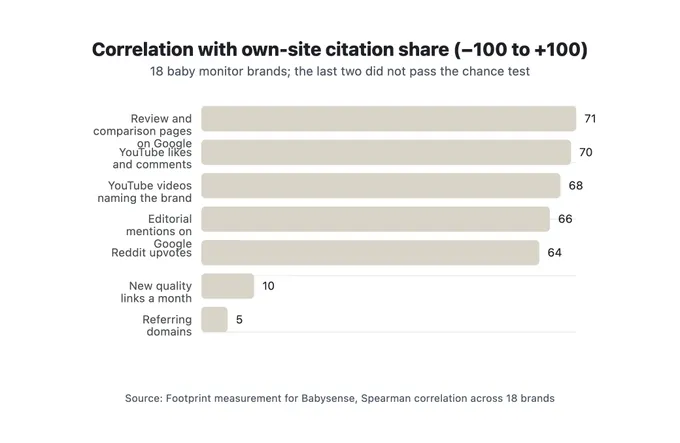
Sixteen of the 46 activities passed. Several are variants of the same activity, such as Reddit upvotes and upvotes a month. Presence on blog, review and comparison pages in Google's results scored +71; YouTube likes and comments (+70), YouTube videos naming the brand (+68), editorial mentions (+66) and Reddit upvotes (+64) sit within seven points of it, too close to rank with 18 brands. Less obvious passes include the number of unique domains that mention the brand (+63) and average page traffic (+59).
Link counts tracked far less. New quality links a month scored +10 and referring domains +5, and neither passed.
Where Babysense sits on review pages, Reddit and YouTube
Nanit, which leads own-site citations, is the useful comparison. VTech and Owlet show the pattern has exceptions.
Activity | Babysense | Nanit | VTech | Owlet |
|---|---|---|---|---|
Blog, review and comparison pages in Google's results | 80 | 186 | 181 | 170 |
Reddit upvotes on posts naming the brand | 2,930 | 23,203 | 4,334 | 23,949 |
YouTube likes and comments on videos naming the brand | 7,463 | 28,865 | 29,254 | 192,995 |
Own-site citation share | 5.6% | 33.6% | 4.7% | 6.5% |
VTech appears on 181 review and comparison pages, close to Nanit's 186, but holds 4.7% of own-site citations. Owlet has more Reddit upvotes and far more YouTube engagement than Nanit and holds 6.5%. Those gaps make review pages, Reddit and YouTube leads worth testing first, with the exceptions in mind. How Footprint tracks Reddit explains how the count is collected.
Step 6: Measure AI visibility again on the same questions
By the end of this step you have a dated series you can trust. Run the same questions on the same engines once a month, and keep every snapshot. Monthly is our recommendation; this measurement has a single comparable snapshot so far.
- Freeze the question set. If you add questions, start a new series. Babysense's earlier measurement used a different, smaller set of 30 questions, so it can't be compared with this one.
- Keep the date, country and engine settings identical.
- Log what you changed between snapshots, such as a list placement won or a video series launched.
- Track the activities as well as the share, so you can see the work happen even before share of voice moves.
Common mistakes when measuring AI visibility
- Mixing branded and unbranded questions. A question that names your brand will usually mention it, so it inflates your share. Keep branded questions out of the headline figure.
- Treating a correlation as a cause. An activity that tracks citation share is a lead worth testing.
- Using one run per question as proof. Answers vary, so repeat each question where you can.
Limits of this AI visibility measurement
The figures in this guide come from one category, in one country, on one day. ChatGPT answered each question once. Answers likely vary from run to run, which we haven't measured, so a gap of two or three mentions between brands may be within that variation. The correlations describe 18 brands at one moment and don't show cause. Babysense has no before-and-after result yet; the next snapshot on the same 135 questions will be the first comparable one.
Frequently asked questions
What is a good AI share of voice?
It depends on how many brands compete. In Babysense's market, with 18 tracked brands, the ChatGPT leader held 22.1% of mentions and the AI Overviews leader 15.6%, so Babysense's 6.4% on ChatGPT ranked seventh. Track your own figure monthly and compare it with the top three brands.
How many prompts do I need to measure AI visibility?
As a rule of thumb of ours, 20 to 30 buyer questions give a first reading. For a figure you can break down by product line or intent, use more; Babysense's measurement uses one question per keyword, 135 in all.
What is the difference between a mention and a citation?
A mention is your brand named in an answer. A cited mention has a source link in the same passage, and the link can go to your site or to a third-party page. Footprint counts the ones that link to your own site as own-site citations. On ChatGPT, 6 of Babysense's 17 mentions were own-site citations.
Which AI engines should I measure?
ChatGPT and Google AI Overviews at a minimum, the two measured here. Add Gemini, Claude and Perplexity if buyers in your market use them. Readings differ by engine: Babysense had 6.4% on ChatGPT and 14.6% in AI Overviews.
Babysense had three readings on one day: 6.4%, 14.6% and 1.3%
One figure hides most of the picture: Babysense reads 6.4%, 14.6% or 1.3% depending on the engine and the weighting. Across 18 brands, presence on review and comparison pages and YouTube engagement tracked own-site citations most strongly among the activities tested, with the top five within seven points, while link counts barely did. Run the six steps on your market, keep the question set fixed and measure again next month.
To see how ChatGPT and Gemini treat your brand today, run the free AI visibility checker. For a full measurement of your market, book a demo. Choosing a tool first? Our comparison of the best AI visibility tools covers what each one measures.
Sources
G2, "The Answer Economy: G2's 2026 AI Search Insight Report", vendor survey of 1,076 B2B decision makers.
Footprint methodology. Measurement for Babysense of ChatGPT (135 questions) and Google AI Overviews (270 searches), United States.