Best AI Visibility Tools: 6 Compared on Price and Engines
The best AI visibility tools compared on price, engines and prompts: Otterly, Peec AI, Semrush, Ahrefs, Scrunch and Profound, from vendor pages.


Updated November 11, 2026
In this article
Best AI visibility tools compared: price and prompts
How we chose the best AI visibility tools
1. Otterly AI: best low-cost way to start
2. Peec AI: best for a whole team on a public price
Show More
The best AI visibility tools depend on what you already pay for: Otterly AI for the lowest entry price ($29 a month, or €29 by location, for 16 prompts), Peec AI for team seats, Semrush or Ahrefs if you already use them, Scrunch for personas, Profound for the widest engine list. No two tools count the same thing: Scrunch, the largest published plan, includes 350 prompts at about ten times Otterly's price, and the others count in prompts, checks, credits or per-domain licenses.
An AI visibility tool, also called an AI visibility platform, asks AI engines such as ChatGPT, Gemini and Google AI Overviews the questions your buyers ask, and counts how often the answers name you.
We read each vendor's own pricing and product pages at the time of writing and compared six tools on the engines they ask, the questions you get, the entry price and what they count beyond the answer. This is a reading of vendor pages, not a test of the tools.
Want AI SEO tools that also help you change your content? See the best GEO tools; this article covers AI search visibility tools that measure.
Footprint, which publishes this article, also sells an AI visibility product. It isn't one of the six; we describe it separately, with its limits, in "Where Footprint fits". New to the topic? Start with how to measure AI visibility.
Key takeaways
- Otterly AI has the cheapest published entry: $29 a month (or €29, by location), for 16 prompts.
- Scrunch includes the most prompts at entry (350) and lists seven platforms on every plan, from $300 a month.
- Profound tracks up to nine engines on Enterprise but publishes no price.
- Peec AI includes unlimited seats on every plan, from $95 a month, and is the only one of the six to state it.
- Only Ahrefs Brand Radar describes Reddit and YouTube data.
- Scrunch, Otterly and Profound offer a free trial; Peec's length is not stated and Semrush has none.
Best AI visibility tools compared: price and prompts
The cheapest AI visibility tool is Otterly AI at $29 a month. Peec AI suits teams with unlimited seats, Semrush and Ahrefs suit their own customers, Scrunch fits persona work, and Profound has the widest engine coverage at a custom price. Units differ: Ahrefs meters checks, Otterly meters credits, and Semrush, Peec and Scrunch state prompts, so a prompt count alone does not compare plans.
Tool | Lowest published price | Prompts at entry | Engines | Free trial | Beyond the answer |
|---|---|---|---|---|---|
Otterly AI | $29 or €29 a month | 16 on 4 engines (credits) | Any of 7, in credits | Yes, no card | On-page recommendations, content audit, API |
Peec AI | $95 a month | 50 | 3 of 6; more as add-ons | Yes, length not stated | Citations, recommendations, agent analytics |
Semrush toolkit | $99 a month per domain | 25 | Up to 5, by report | No | Prompt Research, Site Audit checks |
Ahrefs Brand Radar | $129 a month (Ahrefs Lite plan) | 5 (150 checks a month) | 6, plus Claude | Not described | Research index, Reddit and YouTube beta |
Scrunch | $300 a month | 350 | 7 | 7 days, no card | Citations, agent traffic, page audits, personas |
Profound | Custom | Custom (trial: 50 a day, preset prompts) | Up to 9 on Enterprise | 7 days | Agent analytics, ChatGPT Shopping, AI Marketer drafting |
How we chose the best AI visibility tools
We picked six tools that publish their plan details: Profound, Peec AI, Otterly AI, Scrunch, the Semrush AI Visibility Toolkit and Ahrefs Brand Radar. Other tools exist; we did not review them. The "Best for" labels are our reading of the plan details, not test results.
The sections run from the lowest published entry price to the highest, with Profound, which publishes none, last. For each tool we checked four things:
- Engines: which AI engines the entry plan asks, and what higher plans add.
- Prompts: how many buyer questions the entry plan tracks, and in what unit usage is metered.
- Price: the lowest published monthly price.
- Beyond the answer: citations, AI crawler visits, page audits, prompt research, and Reddit or YouTube data.
For Footprint's own approach, see how Footprint measures.
1. Otterly AI: best low-cost way to start
Otterly AI has the lowest published entry price of the six. See how Footprint compares with Otterly AI.
What Otterly AI tracks
Otterly tracks brand mentions and the links engines cite, reports share of voice against competitors, and adds on-page recommendations and a content audit. From the Standard plan it adds agent analytics (which AI crawlers visit your pages), an API and an MCP server, a connector that lets AI assistants read your data.
Otterly AI pricing and credits
Otterly recently changed its plans, and engines moved to a credit system (Otterly help). Every plan can track any of seven engines: ChatGPT, Google AI Overviews, Perplexity, Copilot, Google AI Mode, Gemini and Claude.
Engines cost different amounts: Otterly lists Claude at 3 credits per check, and Gemini and AI Mode at 1. Lite costs $29 a month (or €29, by location), and its monthly credits cover 16 prompts on four engines (Otterly's example). Standard costs $189 a month for 120 prompts; the page's engine count for that plan is not stated.
Every paid plan has a free trial with no card required (Otterly pricing).
Limits: credits mean 16 prompts only if you use four engines.
Best for: trying AI visibility at low risk, or getting the data into your own stack through the API.
2. Peec AI: best for a whole team on a public price
Peec AI includes unlimited seats on every plan, the only one of the six that states this on the pages we read. Scrunch includes three seats and charges $25 a month for more, and Semrush needs another license per extra user. See how Footprint compares with Peec AI and Peec AI alternatives.
What Peec AI tracks
Peec reports visibility (the share of chats that mention you), position, sentiment and the citations behind your visibility. It adds AI-suggested prompts with search volumes, recommendations, and agent analytics that show how AI agents crawl your pages.
Peec AI pricing and seats
Starter costs $95 a month for 50 prompts in one country (Peec pricing). You choose three engines from ChatGPT, Google AI Mode, AI Overviews, Copilot, Gemini and Naver AI.
Pro costs $245 a month for 150 prompts, three countries and the API. More models, Perplexity among them, are paid add-ons, and Claude is listed on Enterprise. The pricing page offers a free trial without stating its length.
Limits: three engines on Starter, and Perplexity is an add-on.
Best for: teams that need several people in the tool and find three engines enough.
3. Semrush AI Visibility Toolkit: best for Semrush customers
The Semrush toolkit puts AI tracking in the same login as your Semrush keywords and audits, so it is the shortest path for a team that already works there. See how Footprint compares with the Semrush AI toolkit.
What the Semrush toolkit tracks
The toolkit includes Prompt Tracking, Prompt Research for finding the questions people ask, and AI search checks in Site Audit. Semrush's help pages list Google AI Mode, AI Overviews, ChatGPT, Gemini and Perplexity, with the engines differing by report.
Semrush toolkit pricing and licenses
The toolkit costs $99 a month per domain and includes 25 tracked prompts (Semrush help). Each extra user needs another license at the same price, and Semrush says the toolkit has no free trial.
Limits: 25 prompts, and a separate license for each extra user.
Best for: existing Semrush customers who watch a small, fixed set of questions.
4. Ahrefs Brand Radar: best for researching a category
Brand Radar is a research index as much as a tracker. Its AI Visibility Index covers what Ahrefs calls 551 million real prompts, and Ahrefs says more than 3,000 companies use Brand Radar (Ahrefs Brand Radar). See how Footprint compares with Ahrefs Brand Radar.
What Ahrefs Brand Radar tracks
Custom prompt tracking covers AI Overviews, AI Mode, ChatGPT, Perplexity, Gemini and Copilot, plus Claude. Brand Radar is also the only tool of the six that describes Reddit and YouTube data: beta indexes of YouTube, TikTok and Reddit mentions, free while in beta, announced earlier (Ahrefs).
Ahrefs Brand Radar pricing and checks
Custom prompts come with Ahrefs plans: 5 on Lite, at $129 a month (Ahrefs pricing), with more on each higher plan. That is the price of the whole Ahrefs Lite plan, which includes Brand Radar prompts, not a Brand Radar-only price.
Usage is metered in checks, one per prompt per platform per location, and a Claude update costs 8 checks. Lite includes 150 checks a month. The AI Visibility Index add-on starts at $199 a month (the pages we read don't say whether Lite prompts need it).
Limits: 5 prompts on Lite, and Claude updates use checks fastest.
Best for: Ahrefs customers who want to research a category before they decide what to track.
5. Scrunch: best for personas and AI-readable pages
Scrunch describes benchmarks by buyer persona and an Agent Experience Platform (AXP) that generates an AI-friendly version of your site. None of the other five describes either. See how Footprint compares with Scrunch.
What Scrunch tracks
Scrunch lists seven platforms on every plan: ChatGPT, Claude, Gemini, Perplexity, Google AI Mode, AI Overviews and Meta (Meta AI). It adds citation tracking, agent traffic monitoring, page audits and persona benchmarks.
Scrunch pricing and personas
Starter costs $300 a month for 350 custom prompts (Scrunch pricing). It is $250 a month if billed annually; other vendors' annual prices are not compared here.
It includes three seats, three personas and five page audits, and extra seats cost $25 a month. A 7-day trial of Starter needs no credit card.
Limits: the highest published entry price of the six.
Best for: teams that sell to distinct buyer personas or want an AI-readable layer on their site.
6. Profound: best for enterprise engine coverage
Profound tracks the most engines of the six. It says it raised $180 million in a Series D round (Profound). See how Footprint compares with Profound and Profound alternatives.
What Profound tracks
Enterprise lists nine engines: ChatGPT, Perplexity, Google AI Mode, Gemini, DeepSeek, Claude, Google AI Overviews, Exa Search and Muse Spark, as the page names them. It adds agent analytics, ChatGPT Shopping visibility, SSO/SAML (single sign-on), SOC 2 compliance and AI Marketer credits for drafting work.
Profound pricing and engines
Profound publishes no price for brands: Enterprise is custom (Profound pricing). A free 7-day trial runs 50 prompts every day on ChatGPT, Gemini and AI Overviews, and trial users get a recommended set of prompts for their industry rather than their own.
Limits: no published price, and the trial does not use your own prompts.
Best for: enterprises that need DeepSeek or Exa tracked and have an in-house team to act on the data.
Price and prompts in charts
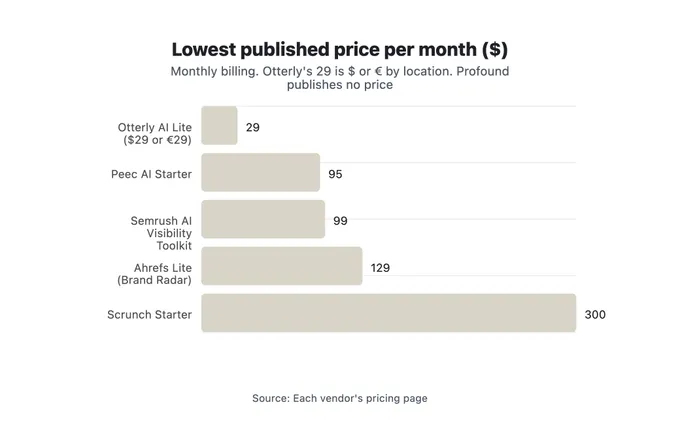
Scrunch costs about ten times Otterly's entry price. The chart shows the lowest published monthly price of the five tools that publish one.
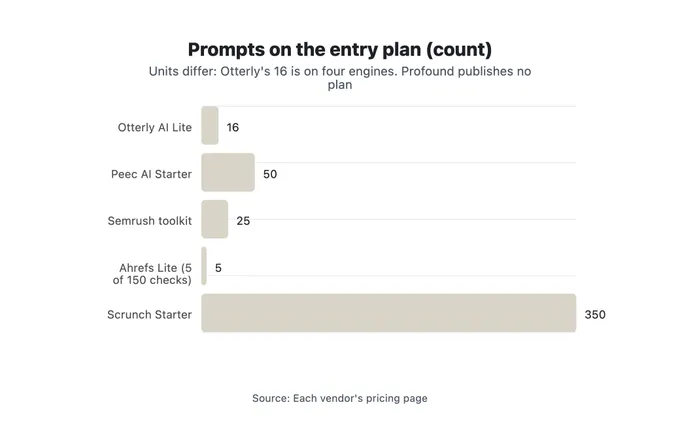
Scrunch includes about 22 times as many prompts as Otterly's 16, but the units differ: Ahrefs's 5 are prompts inside a 150-check allowance, and Otterly's 16 assume four engines. Profound is left out because it publishes no plan.
What the AI visibility tool pages don't describe
We found no description, in the pricing and product pages we read, of the next step after counting the answers: testing which public activities, such as review pages, Reddit threads or YouTube videos, line up with AI visibility across your competitors. That is based on the pages, not on using the tools, and "not described" does not mean absent.
What 46 activities showed for 18 baby monitor brands
Footprint measured 18 baby monitor brands for Babysense, a Footprint customer that agreed to publish its numbers (Babysense case study). We tested 46 activities against site-linked share: the share of all site-linked mentions that went to a brand, where a site-linked mention is a mention with a link to that brand's own website in the same answer passage. The mentions come from ChatGPT answers with web search on.
Each test used a Spearman rank correlation, reported from −100 to +100, and a permutation test at p < 0.05.
Sixteen activities passed, against about 2 expected by chance. The table shows five of the 16 that passed, led by the strongest, and two link measures.
Activity | Correlation with site-linked share | Passed the chance test |
|---|---|---|
Blog, review and comparison pages on Google that name the brand | +71 | Yes |
Likes and comments on YouTube videos that name the brand | +70 | Yes |
YouTube videos that name the brand | +68 | Yes |
Reddit upvotes on threads that name the brand | +64 | Yes |
Unique domains mentioning the brand on Google | +63 | Yes |
New links a month from quality sites | +10 | No |
Referring domains | +5 | No |
In this market, review pages and YouTube had higher rank correlations with site-linked share than the link measures. The table shows two of the six link measures; none of the six passed, with correlations from −3 to +30. The strongest results are leads worth testing, not findings. See how the activities are measured.
Where Footprint fits
Footprint is our product, so read this section as a vendor describing itself. It measures share of voice on ChatGPT (asked with web search on), Gemini, Claude, Perplexity and Google AI Overviews, using questions written from your keyword list. See AI share of voice.
It then counts the Reddit, YouTube, Google, LinkedIn and website activity of every brand in your market, tests each activity against site-linked share, and turns the leads into a roadmap its team can carry out.
What Footprint doesn't do
- It tracks five engines and doesn't measure Google AI Mode, which all six tools here list. It also doesn't cover Copilot, DeepSeek, Meta, Exa, Naver AI or Muse Spark.
- It has no ChatGPT Shopping tracking, persona benchmarks or AI-readable page layer like AXP.
- It has no self-serve plan, public price or free trial; its three packages are priced after a demo (pricing).
- It has no research index of other categories: it measures your market.
If you have people to act on recommendations and the engines above cover your buyers, one of the six may be all you need. Each tool has a one-on-one comparison on our compare page.
How to choose the best AI visibility tool
- Which engines do your buyers use? Find the cheapest tier of each tool that includes all of them, and compare those prices.
- Which trial lets you test your own prompts? Scrunch gives 7 days with no card, Otterly lists a free trial with no card, and Profound's trial uses a preset prompt list.
- Do you need the sources behind the answers? (See how ChatGPT citations work.) If Reddit threads and videos shape your category, check what each tool says it measures there.
- Who does the work? Otterly, Peec and Profound list recommendations or drafting features; decide who will act on them before you buy.
What this comparison can't show
- What we didn't do. We didn't run the same prompts through each tool, so we don't rank them on accuracy.
- What "not described" means. Where a vendor's pages don't mention a feature, we say so, which doesn't mean the tool lacks it. Plans can change without notice, as Otterly's did on the day we checked.
- What the correlations are. They describe 18 brands in one market at one moment and don't show cause.
Frequently asked questions
How are AI visibility tools different from AI SEO tools?
An AI visibility tool, or ChatGPT SEO tool, measures; AI SEO tools also help you change content. An AI visibility tool asks AI engines such as ChatGPT, Gemini and Google AI Overviews a fixed set of buyer questions and counts how often each brand is named. Most report share of voice, the sources the answers cite and how both change over time.
How much do AI visibility tools cost?
Published entry plans run from $29 a month (or €29) for Otterly AI to $300 a month for Scrunch. Peec AI is $95, Semrush's toolkit $99 per domain and Ahrefs Lite $129. Profound publishes no price. We read these at the time of writing, and plans change often.
What is the best AI visibility tool?
It depends on what you already pay for. Otterly AI has the lowest entry price, Peec AI includes unlimited seats, Semrush and Ahrefs suit their own customers, Scrunch fits persona work and Profound lists the most engines. No two tools count the same thing, so compare plans on your own questions.
Is there a free AI visibility tool?
Several tools offer free trials, not free plans. Scrunch gives 7 days with no card and Profound 7 days on a preset prompt list. Otterly lists a free trial with no card, Peec AI one of unstated length, and Semrush has none. Footprint also offers a free AI visibility checker.
Pick the tool that matches who acts on the data
Entry prices run from $29 to $300 a month. Run the free checker first, then trial two or three tools on the same set of prompts.
None of the pages we read describes testing which activities track visibility. In the one market we showed, review pages (+71) had a higher rank correlation than new links (+10), which is a lead worth testing. Start with the free AI visibility checker. To see the activity tests and a roadmap for your market, book a demo.
Sources
Footprint methodology. Measurement for Babysense, 18 baby monitor brands, 46 activities, ChatGPT with web search on, United States.