Best GEO Tools: 7 Compared on Price, Engines and Limits
Best GEO tools compared: 7 generative engine optimization tools by verified price, prompt limits and engine coverage, plus data on why one engine misleads.


Updated November 11, 2026

In this article
The 7 best GEO tools at a glance
How we chose the best GEO tools
One engine can give a misleading picture
1. Otterly AI: best low-cost GEO tool for a first measurement
Show More
The best GEO tools depend on which AI engines your buyers use and who on your team will do the work. Generative engine optimization (GEO) tools, also called AI search optimization tools, measure how often engines such as ChatGPT, Gemini, Claude, Perplexity and Google AI Overviews name your brand. This page compares seven by price, prompt limits and engines, using each vendor's pricing page at the time of writing. Our AI visibility tools comparison goes deeper on the trackers alone.
Quick picks:
- Cheapest way to start: Otterly AI, from €29 a month.
- Already on Semrush or Ahrefs: stay in that tool and add its AI module.
- Enterprise security review: Profound.
- No one to do the work: Footprint, our own product, where our team ships the work.
Key takeaways
- The best GEO tools publish entry prices from €29 a month (Otterly AI) to $300 a month (Scrunch). Profound and Footprint publish no price.
- Check the engines in the plan you would buy, as well as its price. Peec AI, for one, offers Claude and Perplexity only on Enterprise.
- For Babysense, ChatGPT ranked the brand seventh of 18 and Google AI Overviews ranked it second, so one engine can give a misleading picture.
- Tools differ in what they do after measuring: some stop at the number, some draft recommendations, and one ships the work.
The 7 best GEO tools at a glance
Among the best GEO tools, the right pick depends on engines and who does the work. Otterly AI (€29 a month) and Peec AI ($95) are the cheapest ways to start measuring, Semrush and Ahrefs suit teams already on those suites, Scrunch suits large sites, and Profound suits enterprise security review.
The table lists the cheapest plan that tracks your own prompts for each tool, from each vendor's pricing page at the time of writing. "Kind" uses the three types defined further down, and only what the vendor's page states.
Tool | Kind | Entry price a month | Prompts or checks on entry plan | Engines on entry plan or trial |
|---|---|---|---|---|
Measures, plus 3 recommendations a week | €29 (excl. tax) | 16 prompts | 4 of 7 | |
Peec AI | Measures, plus drafts (500 agent credits) | $95 | 50 prompts | 3 chosen from 6 |
Measures, plus AI-generated recommendations | $99 | 25 prompts | ChatGPT and Google AI Mode named | |
Measures, plus prompt research | $129 (plan price) | 150 checks (one prompt, platform and location each) | 7 listed, plan not specified | |
Scrunch | Measures; also describes an agent-facing site version (AXP), plan not specified | $300 ($250 billed annually) | 350 prompts | Not tied to plan |
Profound | Measures, plus drafts through AI Marketer | Custom (free 7-day trial) | 50 on the trial | 3 on the trial, up to 9 on Enterprise |
Does the work | Custom, per market | From your keyword list | 5 |
Check-based and prompt-based limits are not directly comparable: a prompt tracked on three engines uses three checks. Prices are in each vendor's own currency, and Otterly's excludes tax, so the order is approximate across currencies.
How much do GEO tools cost?
Published GEO tool prices run from €29 a month (Otterly AI) to $300 a month (Scrunch) for plans that track your own prompts. Peec AI starts at $95, Semrush at $99 and Ahrefs at $129. Ahrefs also sells custom prompt packages from $50 a month, but its page doesn't say what they include, so we ordered it by its plan price. Profound and Footprint publish no price. Plans differ in prompts and engines, so compare those as well as price. For a free baseline before you pay, use the free AI visibility checker.
How we chose the best GEO tools
We kept tools that publish a pricing or plan page in English and track brand mentions across several AI engines, then recorded the entry price, prompts, engines, seats and what each does after it measures. The list is not exhaustive. We left out tools without a public plan page, such as enterprise platforms that sell only through sales calls. We did not review tools that only publish pricing on request.
What are generative engine optimization tools?
GEO tools, also called LLM SEO tools, measure how often AI engines name your brand when buyers ask category questions. Some stop at the measurement, some draft the fixes, and some do the work. The term comes from an academic paper that reported up to 40% higher visibility on its own benchmark (Aggarwal et al., GEO: Generative Engine Optimization). Our guide to what generative engine optimization is covers the basics, and AI SEO covers the wider practice.
Three kinds of GEO tool
- It measures. It asks AI engines your buyers' questions and counts the answers that name you.
- It drafts. It turns the gap into recommendations, briefs or drafts for your team to publish.
- It does the work. Someone ships the posts, videos, links and pages, then measures again, as in generative engine optimization services.
The ranking rule
We sorted the list by the lowest published monthly price for a plan that tracks your own prompts. Tools without a public price come last, and our own product goes last among them, which puts Footprint at number seven. We chose price because anyone can check it.
What this comparison can't show
We read each vendor's pricing page and ran no hands-on benchmark, so quality and accuracy are outside its scope, and plans can change after we read the pages. No vendor paid for placement. Footprint is our product, so we describe it with the same fields as the others.
One engine can give a misleading picture
We sent 135 buyer questions to OpenAI's API with web search turned on (the model behind ChatGPT) for Babysense, a baby monitor brand and a Footprint customer that agreed to publish its numbers. We also recorded Google AI Overviews for the same 135 keywords. Share is a brand's mentions divided by all brand mentions among the 18 tracked brands. The measurement covers ChatGPT and Google AI Overviews.
ChatGPT ranked Babysense seventh, naming it 17 times out of 267 brand mentions (6.4%). AI Overviews ranked it second only to Nanit, naming it 70 times out of 481 (14.6%).
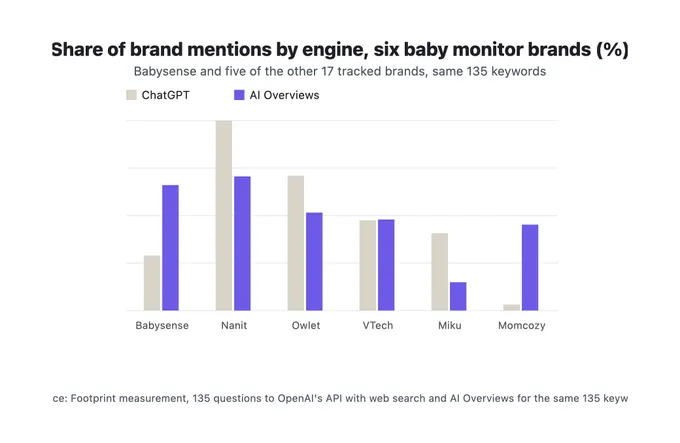
Momcozy shows the gap more sharply, with 2 ChatGPT mentions and 48 in AI Overviews. The Babysense data shows rankings differ by engine, so check which engines your plan includes as well as its price. The full story is in our Babysense share of voice study and the AI share of voice report.
1. Otterly AI: best low-cost GEO tool for a first measurement
Otterly AI has the lowest published entry price on this list: €29 a month for 16 prompts tracked daily.
What it does: tracks brand visibility, sentiment and cited sources, and the Lite plan adds 3 recommendations a week. Standard and higher add unlimited recommendations and API access.
Engines: ChatGPT, Google AI Overviews, Perplexity, Microsoft Copilot, Google AI Mode, Gemini and Claude are named.
Limits: each plan below Enterprise includes 4 of the 7 engines, and the page doesn't say which four. A Claude answer costs 3 credits.
Pricing: Lite costs €29 and Standard €189 a month, excluding tax. Plans are metered in credits.
Source: Otterly AI pricing; see also our Otterly AI comparison.
2. Peec AI: best GEO tool for unlimited seats
Peec AI includes unlimited seats on every plan, so a whole team can use it without per-seat fees, which suits a marketing team or a small agency.
What it does: tracks prompts daily and adds agent credits for its recommendation features, 500 a month on Starter.
Engines: you choose 3 engines from ChatGPT, Google AI Mode, Google AI Overviews, Microsoft Copilot, Gemini and Naver AI.
Limits: Claude and Perplexity are on Enterprise only, so a Claude or Perplexity audience decides the plan before price does. Starter tracks 50 prompts.
Pricing: Starter costs $95 a month. Enterprise is custom, billed annually, with single sign-on.
Source: Peec AI pricing; see also our Peec AI comparison.
3. Semrush AI Visibility Toolkit: best for existing Semrush users
The Semrush AI Visibility Toolkit puts AI answers into the same tool many SEO teams already pay for, so an SEO team on Semrush can keep them in the same reports.
What it does: prompt tracking plus Brand Performance, which reports share of voice, sentiment and "AI-generated strategic recommendations".
Engines: the toolkit page names ChatGPT and Google AI Mode.
Limits: each extra user needs their own license, and the engine list on the toolkit page is short, so ask Semrush which others are in the $99 plan.
Pricing: $99 a month for 25 tracked prompts, according to Semrush's knowledge base. Semrush's SEO plans also bundle AI visibility, starting at $199 a month.
Sources: Semrush knowledge base and Semrush pricing; see also our Semrush AI Visibility Toolkit comparison.
4. Ahrefs Brand Radar: best for researching prompts first
Ahrefs Brand Radar pairs your own prompts with an index that Ahrefs says holds more than 551 million prompts, which helps when you don't yet know what buyers ask. It suits an Ahrefs customer who wants to research the questions before tracking a short list.
What it does: prompt research across that index, plus tracking for prompts you define.
Engines: AI Overviews, AI Mode, ChatGPT, Perplexity, Gemini and Copilot, and Claude, which the page doesn't tie to a plan.
Limits: the plan is metered in checks, not prompts, and one check is one prompt on one platform in one location.
Pricing: Ahrefs plans start at $129 a month with 150 AI prompt checks. Custom prompt packages start at $50 a month.
Sources: Ahrefs pricing and Brand Radar; see also our Ahrefs Brand Radar comparison.
5. Scrunch: best for a large site that AI agents struggle to read
Scrunch is the only tool on this list that describes an agent-facing version of your site, though its page doesn't say which plans include it. It suits a brand whose own pages are the gap, with a large site that AI agents struggle to read.
What it does: monitors brand presence across AI engines and offers its Agent Experience Platform (AXP), which in Scrunch's words "creates a parallel, lightweight version of your site that's translated for AI agents."
Engines: the pricing page doesn't tie engines to plans.
Limits: the pricing page doesn't say which plans include AXP or which engines each plan tracks.
Pricing: Starter costs $300 month-to-month, or $250 a month billed annually, for 350 custom prompts. Enterprise adds SAML or OIDC single sign-on and a Data API.
Source: Scrunch pricing; see also our Scrunch comparison.
6. Profound: best GEO tool for enterprise security review
Profound sells to large companies and publishes no price. It suits a large company that needs SSO, SCIM and SOC 2 before procurement signs, and has writers to publish the drafts.
What it does: tracks prompts daily, and its AI Marketer identifies work worth doing, drafts it and asks for your approval.
Engines: the trial covers ChatGPT, Gemini and Google AI Overviews; Enterprise covers up to 9 engines.
Limits: no public price, and the trial is 7 days and 50 prompts.
Pricing: custom, after a free trial.
Sources: Profound pricing and Profound home page; see also our Profound comparison.
7. Footprint: best when nobody on your team has the hours
Footprint is our product, so weigh this entry with that in mind. Among the pages we read for this list, Footprint is the only one whose own team ships the work.
What it does: tracks about 50 measures, mostly activities, for you and every competitor, such as mentions in Google's list articles, Reddit threads, YouTube videos and links. It tests each against links to the brand's own website in AI answers (how Footprint tests each signal), turns the ones that pass into a monthly roadmap with a budget, and its team ships it. Its AI share of voice report shows where you stand first.
Engines: ChatGPT, Gemini, Claude, Perplexity and Google AI Overviews, with questions generated from your keyword list in the market's language.
Limits: no self-serve plan and no public price.
Pricing: see Footprint pricing.
What evidence should a GEO tool show for its advice?
Ask any vendor that recommends actions to show evidence like this for your market. Here is Footprint's own analysis for Babysense, as an example of what to ask for. Of Footprint's 50 measures, 46 had data for Babysense's market, and we correlated each with the brands' site-linked share: the share of all site-linked mentions that went to a brand, where a site-linked mention is a mention with a link to that brand's own website in the same answer passage. A correlation of +71 on a −100 to +100 scale means brands with more list-article mentions also tended to have a larger site-linked share.
A permutation test checks whether a result that strong would happen by shuffling alone. Sixteen measures passed it at p < 0.05, against about 2 that would pass by chance (5% of 46). Several of the 16 measure the same activity, so read them as leads worth testing.

The 16 significant measures ranged from +46 to +71. The strongest cluster was Google list articles (+71), YouTube engagement (+70) and Reddit upvotes (+64). The counterexamples were the backlink measures: new quality links scored +10, backlink volume +14 and backlink domain traffic +30, and none passed.
Babysense appears in 80 list-article results, fifth of 18 brands, while Nanit, VTech and Owlet appear in 186, 181 and 170. List articles are one place to test first.
Which of the best GEO tools should you choose?
You rarely need two measuring tools. Each asks different prompts on a different schedule, and the numbers will not match.
- You have writers, a community manager and someone who earns links. Choose a tool that measures, such as Otterly AI, Semrush or Ahrefs. They don't need recommendations.
- You have one or two people who can publish but not plan. Choose a tool that drafts or recommends, such as Peec AI or Profound. It saves them the writing time.
- Nobody has the hours. Look for a vendor that ships the work, and ask to see the measurement behind it.
Questions to ask any vendor
- Which engines are in the plan I would buy? Ask for the list in writing, for that plan.
- Who writes the prompts? Your buyers' questions in your market's language beat a generic list.
- Do you count every brand the answers name, or only the ones I enter? The brand taking your place may be one you weren't tracking.
- What do you measure besides the answer? Cited pages at least, and ideally the Reddit threads, videos and list articles the answers cite. Our guide to how to measure AI visibility lists what to track.
- What happens after the dashboard? Ask which of the three kinds the vendor sells.
Frequently asked questions
What is the best GEO tool?
No single tool wins on every plan; match the tool to your engines and to who does the work, then compare prices.
Are GEO tools and AI visibility tools the same thing?
Mostly. GEO tools, AI visibility tools and answer engine optimization tools all measure how often AI engines name your brand, and the only difference is what comes after the number: some tools stop there, some draft recommendations, and some do the work. For how the three terms differ, see AEO vs GEO vs SEO.
How many prompts do I need to track?
Enough to cover the questions your buyers actually ask, in each market. Our Babysense measurement used 135 questions built from its keyword list, so a plan with 16 or 25 prompts covers a narrow slice of a category. The prompt generator can draft a starting list.
Are ChatGPT SEO tools enough?
Not if your buyers use other engines. Tools that track only ChatGPT, whose citation behavior differs from other engines, can miss the rest. Babysense ranked seventh of 18 brands on ChatGPT and second on Google AI Overviews for the same keywords, so either engine alone can give a different picture from the other, for this brand on this date.
Match the plan to your engines and your team
What each GEO plan covers matters as well as what it costs. Peec AI's $95 plan lets you choose 3 of 6 engines, while Semrush's toolkit page names ChatGPT and Google AI Mode, so ask Semrush which others its $99 plan includes. Check the engines in each plan alongside the price, then decide who will do the work.
Before you talk to any vendor, get a baseline with the free AI visibility checker, so every tool is measured against the same starting number. To see the full measurement and a budgeted plan for your market, book a demo.
Sources
Footprint methodology. Measurement of ChatGPT and Google AI Overviews for Babysense, 135 baby monitor questions and keywords.