GEO vs SEO vs AEO: The Differences, Tested With Data
GEO vs SEO vs AEO: what each one wins, how pages, sites and metrics differ, and what 135 ChatGPT buyer questions in one market showed about ranking.


Updated November 11, 2026

In this article
GEO, SEO and AEO defined
How GEO, SEO and AEO differ, point by point
Where GEO, SEO and AEO overlap
GEO vs SEO vs AEO: what pages do you write?
Show More
GEO vs SEO vs AEO comes down to what each one tries to win. SEO wins a ranking in Google's links, AEO wins the answer to a direct question in an AI engine, and GEO wins a place in the short list an AI engine writes for an open question.
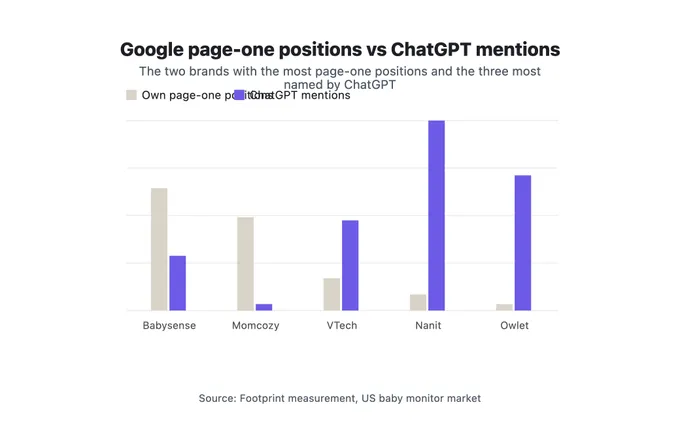
The gap shows up in data. In the US baby monitor market, Momcozy's website held the second-largest share of Google's first page among the 18 brands we track. When we asked ChatGPT the matching buyer questions, it named Momcozy twice. Nanit, whose own site held far fewer positions, was named 59 times.
All three disciplines, often grouped as AI SEO, run on the same web. They part ways in three places that decide where a budget goes: the pages you write, the sites you need to appear on, and the number you report. The data comes from one market we measured, described in the method section below. The market belongs to Babysense, a baby monitor maker and a Footprint customer that agreed to publish its numbers.
Key takeaways
- SEO wins when a page ranks, AEO wins when an AI engine gives your brand as the answer to a direct question, and GEO wins when an AI answer names your brand among a few.
- Ranking and being named came apart: of 18 brands, Babysense's site held the most page-one positions and was seventh in ChatGPT's answers.
- Sites the tracked brands do not own held 89.4% of page-one positions (1,048 of 1,172) for these keywords.
- Of 46 activities tested, 16 tracked ChatGPT's links to brand sites better than chance. Best-of list mentions and YouTube engagement led; page-one rankings did not pass.
- Keep SEO hygiene, treat AEO and GEO as one program, and measure share of voice per engine on a fixed question set.
GEO, SEO and AEO defined
Definitions vary across the industry. This is how we use the three terms in this article.
What is SEO?
SEO (search engine optimization) is the work of getting your pages to rank in Google's and Bing's list of links, and it is judged by rank and clicks. It rests on keywords, page quality and links from other sites.
What is AEO?
AEO (answer engine optimization) is the work of getting an AI engine to give your brand as the answer to a direct question. It mostly runs on pages you publish that answer one question each, and it also covers featured snippets and voice assistants. Our guide covers what answer engine optimization is, and the answer engine optimization service page shows how we run it.
What is GEO?
GEO (generative engine optimization) is the work of getting your brand into the short lists AI engines write for open questions. It mostly runs on earning mentions on pages other people own. See what generative engine optimization is for the longer definition.
The paper that coined the term used GEO for something different: changing your own page so a generative engine cites it. Many practitioners, and this article, use GEO for the off-site side and AEO for the on-page side. Because the paper tested edits to a page's own text, we cite it under AEO below.
How GEO, SEO and AEO differ, point by point
How GEO, SEO and AEO compare on eight points (the AEO and GEO split is Footprint's working definition):
Factor | SEO | AEO | GEO |
|---|---|---|---|
What counts as a win | Your page ranks for the query | The engine gives your brand as the answer | The AI answer names or cites your brand |
Typical query | A keyword: "baby monitor with 2 cameras" | A direct question: "Is a breathing monitor worth it?" | An open question: "What is the best monitor for twins?" |
Where it shows up | Google and Bing results pages | ChatGPT, Perplexity, Claude, Gemini, Google AI Overviews and AI Mode, featured snippets, voice assistants | The same AI engines |
Unit you plan around | Keyword and search volume | The buyer's question, in their words | The question and the brands competing for it |
Pages you write | A page per keyword you want to rank for | A page per question, answered in the first lines | Comparison, alternatives and answer pages worth citing |
Role of other sites | Links that point to your page | Pages that give the same answer you do | The lists, threads, reviews and videos the engine reads |
Main metric | Rank and clicks | Share of voice on direct questions, per engine | Share of voice on open questions, per engine, plus the sources behind it |
Where the effort goes | Your own site, plus links from others | Your own answer pages | Mostly other people's pages |
The AEO and GEO columns look alike because the two share engines, measurement and most of their sources. The main difference is the question type. A direct question with one answer leans AEO; an open question that gets a short list leans GEO. One buyer can ask both kinds in the same afternoon, which is why we measure both from one snapshot.
Where GEO, SEO and AEO overlap
GEO SEO work is not either-or. All three use the same engines, the same buyer questions and the same crawlable pages. What differs is who writes the page that gets cited: you for SEO and AEO, other people for most of GEO. AEO also overlaps with SEO on Google itself, where a good answer page can win a featured snippet or a voice answer as well as an AI citation.
All three also depend on search. When AI engines search the web before answering, they read from search results, so a page no search can find is unlikely to be cited, which is our inference. Google states a version of this for its own features: a page must be "indexed and eligible to be shown in Google Search with a snippet" to appear as a supporting link, with "no additional technical requirements" (Google Search Central). Other engines publish no such rule.
Google also says no AI text files or special structured data are needed (same page). Whether SEO is a floor for ChatGPT is a question our data can neither confirm nor refute, as the sections below show.
GEO vs SEO vs AEO: what pages do you write?
SEO plans pages around keywords and search volume. AEO plans each page around one buyer question, answered in the first lines. GEO adds comparison, alternatives and best-of pages, because lists like these are where AI answers appear to draw their short lists. The keyword list still checks that each page can be found.
How does SEO plan pages?
SEO starts from a keyword list and search volume. You write the page that can rank and judge it by its position. That still matters, because AI engines that search the web draw on search results.
How does AEO plan pages?
AEO uses the buyer's own sentence, often with their situation in it, as the brief. One Babysense question reads: "I want a baby monitor that doesn't rely on WiFi because I'm worried about hacking and our internet is unreliable. What are the best non-WiFi options?" An answer page for it would hold:
- the answer in the first lines, before any background;
- the products that fit, with prices;
- the caveats a buyer would ask about next.
We have not measured whether pages built this way get cited more often, so treat the format as a hypothesis to test. The research that exists points the same way. In the GEO paper, quotations, statistics and source citations raised a page's visibility in AI answers "by up to 40%" relative to the unedited page, on the authors' own benchmark and a simulated engine, while keyword stuffing gave little to no improvement (Aggarwal et al., arXiv 2311.09735). Engines have changed since that paper.
How does GEO plan pages?
GEO adds the pages an engine uses when it builds a shortlist: comparisons, alternatives and "best X for Y" roundups. When no brand writes one, the engine answers from whoever did. If your category has no comparison page, writing one is a reasonable first test. Our generative engine optimization service page describes how that work is scoped.
Verdict: brief new pages from buyer questions, and use the keyword list to check that each page can be found.
GEO vs SEO vs AEO: which sites do you need to appear on?
In SEO, other sites matter mostly as links pointing to your page. In AEO and GEO they are part of what the engine reads. Across the baby monitor keywords, sites the tracked brands do not own, such as retailers, review sites, forums and blogs, held 1,048 of the 1,172 page-one positions, so an engine that reads page one reads mostly other people's pages.
Who owns Google's first page?
Sites the tracked brands do not own hold 89.4% of the page-one positions (1,048 of 1,172); the 18 tracked brands' own sites hold the other 124. Babysense's site held 38 of them, the most of any tracked brand, and Nanit's held 5. A site can hold more than one page-one position for a keyword, which is why 38 positions fall across 33 keywords.
ChatGPT reversed the order. It named Nanit 59 times and Babysense 17 (see how ChatGPT citations work), which put Babysense seventh of 18 brands. The chart shows the two brands with the most positions and the three most named; the full Babysense share-of-voice results rank all 18.
Our guide on how to rank in Google AI Overviews covers that surface. Babysense ranked second for Google AI Overview mentions, behind Nanit's 75, with 70. One possible reason it did better there than in ChatGPT is that ChatGPT's searches return different pages than these keywords do. We cover that split in Babysense in Google AI Overviews.
Which activities tracked ChatGPT's links?
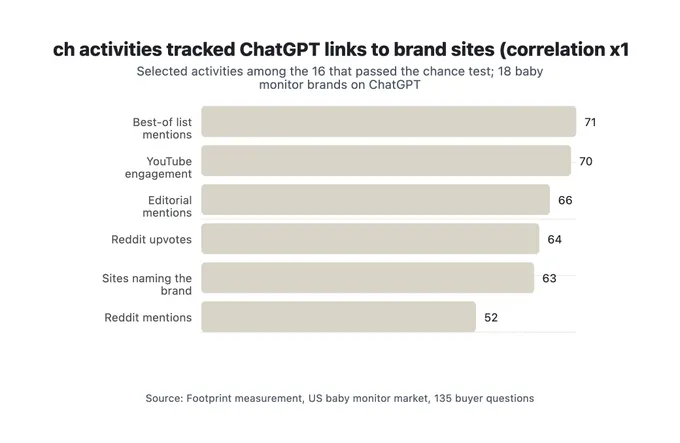
Sixteen of the 46 activities we tested passed our chance test, all with positive correlations. About two would pass by chance alone. Four of the strongest, from four different kinds of activity, were best-of list mentions, YouTube engagement, editorial mentions and Reddit upvotes. They sit within seven points of each other (71, 70, 66, 64) across 18 brands, so the order among them means little. Several YouTube measures track each other, so they are not independent signals.
The target was each brand's site-link share: its mentions where ChatGPT put a source link to the brand's own site in the same passage, as a share of all 107 such mentions. The test used Spearman rank correlations, reported from minus 100 to plus 100, and a permutation test against chance.
Activity | Correlation | Babysense | Highest in market |
|---|---|---|---|
Mentions on best-of lists on Google's page one | +71 | 80 | Nanit, 186 |
YouTube engagement (views, likes, comments) on videos naming the brand | +70 | 7,463 | Owlet, 192,995 |
Mentions in editorial articles on page one | +66 | 72 | VTech, 172 |
Reddit upvotes on posts naming the brand | +64 | 2,930 | Owlet, 23,949 |
Keywords where the brand's own site ranks on page one (did not pass) | +4 | 33 | Babysense, 33 |
Content quality score of the brand's own pages (did not pass) | −38 | 45 | Harbor, 52 |
The two SEO-style measures, rankings and our own-page quality score, did not track ChatGPT's links in this market. The off-site signals have exceptions too: Cubo Ai had the second-highest YouTube engagement and only 11 ChatGPT mentions. Bigger brands also tend to lead on lists, videos and links at once, so these are leads worth testing, not causes. The signals page lists every activity we test.
Verdict: treat the lists, threads and videos that rank for your buyers' questions and name competitors but not you as the first placements to test.
GEO vs SEO vs AEO: what do you measure?
SEO reports rank and clicks, and neither tells you whether an AI answer named you. AEO and GEO need share of voice, the share of all brand mentions that name you, on each engine.
Why do rank and clicks miss AI answers?
Both SEO numbers tell you less when an answer sits above the links. Pew Research Center tracked the browsing of 900 US adults and found that users clicked a traditional result in 8% of visits to Google pages with an AI summary (Pew Research Center). Without a summary, they clicked in 15% of visits. Pew measured browsing on Google, not citations in AI engines.
A rank report cannot tell you whether the summary above your result named you. On buying searches the summary is common: Google showed one on 243 of the 270 baby monitor searches we ran (90%; the 135 keywords plus the 135 questions).
How do you measure AI share of voice?
Share of voice is a brand's mentions divided by all brand mentions on one engine. Report it with its basis, such as "17 of 267 mentions", and per engine, because the engines disagree.
Babysense had 6.4% of ChatGPT's mentions (17 of 267) and 14.6% of Google AI Overview mentions (70 of 481).
Entail, the company behind Footprint, saw a similar split in its own category: across 26 questions, Claude named Entail 12 times and ChatGPT never did (Entail case study). That was a different, smaller question set, so it is not comparable with the baby monitor numbers.
What are cited mentions?
Alongside share of voice, report cited mentions: how often the engine puts a source link in the same passage that names you. The link can go to your site or to someone else's page. The mentions where it links to your own site are the subset we call site-linked mentions, and in the baby monitor market ChatGPT produced 107 of them among its 267 brand mentions (40%). See AI share of voice for how both are calculated.
Verdict: keep the rank report, and report share of voice per engine beside it as the AI number. Our guide on how to measure AI visibility covers the setup, and Google AI Mode explains why Google's AI surfaces are hard to see in analytics.
How we tested the three differences on 135 buyer questions
We asked ChatGPT with web search on 135 baby monitor buyer questions through OpenAI's API, and recorded every tracked brand named in each answer. We also captured Google's first page for the keyword behind each question, and Google's AI Overviews for both the keywords and the questions. Brands were detected automatically from the names and domains of the 18 brands we track. The methodology page explains how we collect and detect brand mentions.
The limits of this run:
- It is one run on one day, with each question asked once, and API answers can differ from what a person sees in the ChatGPT app.
- The ChatGPT counts cover the questions, while the AI Overview counts also include the keyword searches.
- We did not split the 135 questions into direct and open, so the data speaks to AI visibility overall and does not test where AEO ends and GEO begins.
- The correlations describe 18 brands at one moment and do not show cause.
- No Footprint customer has a measured before-and-after result yet.
Footprint sells the measurement tool used here and the services named at the end of this article. Babysense is a customer.
Which one should you invest in?
Start with the questions you lose, on which engine, to which sources. Some starting points by profile:
- A site that is not indexed or loads badly: fix SEO first. Without indexable pages that allow a snippet, Google's AI features will not show you.
- A brand whose buyers ask direct questions: start with AEO answer pages, one question per page, answer first, and test whether they get cited.
- A brand in a category answered with lists: start by testing GEO placements on the lists, threads and videos that name your competitors.
Two rules apply to all three. Keep SEO hygiene in place: indexable pages, snippets allowed, a site that loads. And let the measurement move the money. In this market the activities that tracked ChatGPT's links most closely happened on other sites, so fund earned placements as a test, and look for a change that holds over two or three monthly runs.
Frequently asked questions
What is the difference between GEO, SEO and AEO?
SEO ranks your pages in Google's links. AEO gets an AI engine to give your brand as the answer to a direct question, mostly through your own answer pages. GEO gets your brand into the short list an AI engine writes for an open question, mostly through other sites' pages. All three run on the same web.
Is AEO the same as GEO?
No, but they overlap. AEO vs GEO is mostly a question-type split: AEO targets direct questions with one answer and leans on your own answer pages, while GEO targets open questions answered with a short list and leans on pages other people write. Some sources treat the two terms as synonyms, so check how a vendor defines them.
GEO vs SEO: will GEO replace SEO?
Not on this evidence. GEO vs SEO is not either-or: Google says a page must be indexed and eligible to show with a snippet to appear as a supporting link in its AI features, and other engines that search the web read search results. In the baby monitor data, though, the brand with the most page-one positions was seventh in ChatGPT's answers, so rank alone did not decide who was named.
AEO vs SEO: which should I do first?
On AEO vs SEO and GEO, fix SEO problems that stop pages being found, then test AEO answer pages where your buyers ask direct questions and GEO placements where they ask for lists. Which pays off first depends on your market, and our data does not rank them. Measure each on the same questions every month.
What should I measure for AEO and GEO?
Measure share of voice on each engine (your mentions divided by all brand mentions), and separately the share of your mentions that carry a source link, on the same questions every month. Snapshots built on different question sets cannot be compared, so fix the set before you start.
What the baby monitor data says about GEO vs SEO
In the baby monitor market, the brand with the most page-one positions was seventh in ChatGPT's answers, while mentions on best-of lists, YouTube and editorial articles tracked ChatGPT's links to brand sites most closely. Our data neither supports nor refutes SEO as a floor for ChatGPT, because rank did not track its links here; that claim rests on Google's own documentation.
Run the free AI visibility checker for a first number. Our AI search optimization service runs AEO and GEO as one program, and you can book a demo to see these numbers for your own market.
Sources
Pew Research Center, "Google users are less likely to click on links when an AI summary appears in the results", browsing data of 900 US adults on Google.
Aggarwal et al., "GEO: Generative Engine Optimization", arXiv 2311.09735.
Entail case study: AI share of voice, measurement of 26 questions, a different question set from the baby monitor measurement.
Footprint methodology. Measurement of ChatGPT with web search, Google page one and AI Overviews, US baby monitor market, 135 keywords and 135 buyer questions.