ChatGPT Citations: How ChatGPT Chooses Which Sites to Link
ChatGPT citations are source links in its answers. See how often ChatGPT links a brand's own site, from 0% to 90%, across five markets we measured.


Updated November 11, 2026

In this article
What are ChatGPT citations?
How does ChatGPT choose which sources to cite?
How often does ChatGPT link to a brand's own site?
What do the most-linked brands have in common?
Show More
ChatGPT citations are the source links ChatGPT attaches to passages of an answer when it searches the web. Which ChatGPT sources get those links is only partly under a brand's control: in the five markets we measured, the share of a brand's ChatGPT mentions that linked its own website ran from 0% to 90%.
This guide explains how ChatGPT citations work, what OpenAI's documentation says about them, and what our measurements show about which brands get their own site linked. It ends with what we would test first if you want to know how to get cited by AI.
The data comes from studies we ran with customers who agreed to publish: KELA, Atera, Egnition, Fast Simon and Babysense, all Footprint customers. We also use Entail, the company behind Footprint, as one example.
Key takeaways
- A ChatGPT citation is a source link in an answer. A brand can be named with no link, with a link to a third-party page, or with a link to its own site, and these are three different outcomes.
- With web search on, OpenAI's documentation says answers include inline citations for URLs found in the search results, and that the list of sources the model consulted is often longer than the list it cites.
- Among the most-named brands in each market (at least 10 mentions, 13 or 16 in some), the share of mentions that linked the brand's own site ran from 0% (Mandiant, HaloPSA) to 90% (Group-IB). Fame did not predict it: IBM was linked in 15% of its mentions and CrowdStrike, just as well known, in 65%.
- In four of the five markets, best-of lists, review pages and other third-party coverage on Google tracked own-site links more often than a brand's own pages did. These are correlations across 15 to 28 brands, so they are leads worth testing, not causes.
- ChatGPT answers vary from run to run, so measure a fixed set of questions repeatedly instead of reading one answer.
What are ChatGPT citations?
A ChatGPT citation is a link from a passage of an answer to a web page the answer relies on. When ChatGPT searches the web before answering, it can attach these links so the reader can check where a statement came from. When it answers from training alone, there is usually nothing to link.
For a brand, a citation is the difference between being named and being visited. A passage that names you without a link gives a buyer your name. A passage that links your site gives them somewhere to go. That makes citations the closest thing in AI answers to a click.
Mentions, citations and site-linked mentions
We use three terms and keep them apart:
- A mention is a brand named in an answer.
- A cited mention is a mention with a source link in the same passage of the answer. The link can go to the brand's own site or to a third-party page.
- A site-linked mention is a cited mention where the link goes to the brand's own website. A brand's link rate is its site-linked mentions divided by all of its mentions.
The difference matters because the first question marketers ask, "is ChatGPT linking to us?", has more than one answer. In the baby monitor market, ChatGPT produced 107 site-linked mentions among its 267 brand mentions (40%). The other 60% were either unlinked or linked to someone else.
Outcome | What the answer does | Baby monitor example |
|---|---|---|
Named, no link | Names the brand with no source link | Part of the other 60% |
Linked to a third party | Names the brand and links another site | Part of the other 60% |
Linked to its own site | Names the brand and links the brand's website | 107 of 267 mentions (40%) |
How ChatGPT citations differ from Google rankings
A Google ranking is a position on a list the reader sees. A ChatGPT citation is a link inside a written answer, and the answer may name five brands and link two sites. In our threat intelligence study, an answer named about five brands on average (4.6 across 144 answers). Whether a brand gets its own link is decided passage by passage.
How does ChatGPT choose which sources to cite?
OpenAI does not publish how ChatGPT picks sources, and we do not claim to know. What we can say comes from two places: OpenAI's own documentation of the web search tool, and patterns in the answers we collected.
What OpenAI's documentation says
OpenAI's web search tool documentation says that "by default, the model's response will include inline citations for URLs found in the web search results." Each citation carries the URL, title and location of the cited source. The page also says that when an interface displays information from web results, it "must show inline citations as prominent, clickable links."
Two more details from that page matter for brands. The documentation describes a separate `sources` field that "returns the complete list of URLs the model consulted when forming its response," and notes that "the number of sources is often greater than the number of citations." A page can be read without being linked. This documentation covers the API tool our measurements use; ChatGPT's own app may behave differently. And for a question that needs several sources, it recommends a reasoning model that "can refine its searches as it reads results", which means one question can trigger several searches.
On the crawler side, OpenAI states that OAI-SearchBot "is used to surface websites in search results in ChatGPT's search features," and that "sites that are opted out of OAI-SearchBot will not be shown in ChatGPT search answers" (they may still appear as navigational links). Its crawler page lists GPTBot separately, and says disallowing GPTBot means content should not be used in training. So blocking OAI-SearchBot is the setting OpenAI says keeps a site out of ChatGPT search answers.
What our measurements add
Our share of voice questions go to OpenAI's API with the web search tool on. We record every brand named in each answer and whether a source link sits in the same passage. We cannot see ChatGPT's reasoning, so we describe patterns and label interpretations as interpretations.
One reading that fits the data: a site-linked mention suggests ChatGPT found the brand's site through search for that passage. An unlinked mention may come from what the model already knows, or from a third-party page it cited instead. Our data cannot separate the two.
How often does ChatGPT link to a brand's own site?
In the baby monitor market, ChatGPT linked the brand's own site in 107 of its 267 brand mentions (40%), and across five markets brand link rates ran from 0% to 90%. There is no single figure for how often ChatGPT links a brand, because it depends on the brand and the market. Chart 1 shows selected brands from five markets we measured, each with its own question set, so compare the bars loosely and not as a ranking.
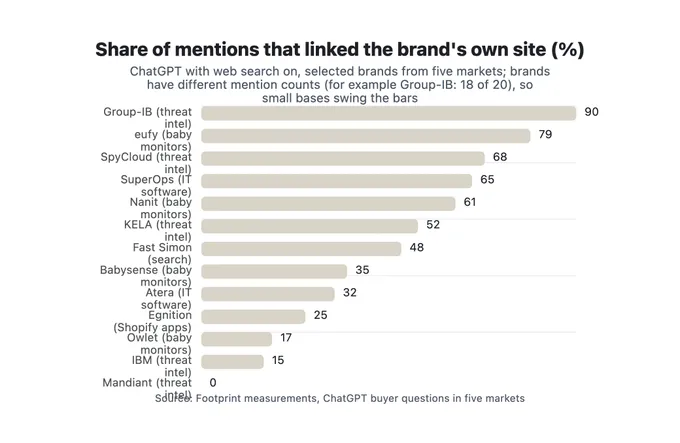
The spread is wide in every market. Here are the ranges, all from ChatGPT with web search on:
Market | Questions | Brands named often | Link rate range | Source study |
|---|---|---|---|---|
Threat intelligence | 144 | 8 brands with 16+ mentions | 0% (Mandiant) to 90% (Group-IB); CrowdStrike 65% | KELA |
IT management software | 143 | 13 brands with 13+ mentions | 0% (HaloPSA) to 65% (SuperOps) | Atera |
Shopify apps | 150 | 8 makers with 10+ mentions | 0% (MageComp) to 58% (Trunk) | Egnition |
Ecommerce search | 148 | 16 brands named | 48% for the two leaders, Fast Simon and Algolia (Athos Commerce at 2% is inflated by product entries, see the Fast Simon study) | |
Baby monitors | 135 | 7 brands in the top rows | 17% (Owlet) to 79% (eufy) |
The ranges are not comparable across rows, because the question sets, brand lists and minimum mention counts differ. What they show together is that no market has a single "ChatGPT links to brands X% of the time" figure.
Big brands are not always linked more
One guess is that ChatGPT skips links for famous brands because it can name them without searching. The data gives one example for and one against. IBM and Mandiant, widely known, had link rates of 15% and 0% in threat intelligence. CrowdStrike, just as well known, was linked in 65% of its mentions. So fame alone does not explain it, and the data does not show a pattern by fame either way.
Being named most does not mean being linked most
In the IT management market, Atera was named 95 times, more than any other brand, and its link rate was 32%. SuperOps was named 49 times and linked 32 of them, a 65% link rate, which gave it more site-linked mentions than Atera's 30. In Shopify apps, Egnition had 56 of 202 mentions and a 25% link rate, while Trunk had 19 mentions and a 58% link rate. In ecommerce search, Athos Commerce led on mentions with 199, and 4 of them (2%) linked its own site; 30 of the 34 links in passages naming it went to other sites, likely including klevu.com and searchspring.net, whose products our detection counts under Athos Commerce. We left it out of the chart for that reason.
One possible reading is that ChatGPT names some brands from what it already knows about a category and earns links for others through pages that search returns. The measurements do not prove that.
What do the most-linked brands have in common?
For each market we counted dozens of activities per brand, such as best-of list mentions on Google, Reddit posts, YouTube engagement and backlinks, and compared each with the brand's share of all site-linked mentions. We used a Spearman rank correlation across the tracked brands, reported from −100 to +100, and kept a result only when a permutation test of up to 5,000 shuffles gave p < 0.05.
The tests ran across 15 to 28 brands and 42 to 47 activities per market. About 5% of the activities would pass by chance alone, which is roughly two per market, so we treat every pass as a lead worth testing.
Third-party pages on Google came up in most markets
Market (brands) | Third-party page activity that passed | Correlation |
|---|---|---|
Ecommerce search (22) | Presence on best-of, review and comparison pages in Google results | +90 |
Baby monitors (18) | Blog, review and comparison pages on Google that mention the brand | +71 |
IT management software (23) | Best-of lists and review pages in Google's results that name the brand | +51 |
Threat intelligence (28) | Google results for early-research questions, such as explainers and lists | +54 |
The Atera and threat intelligence rows show their best-of or early-research measure, not their strongest overall. In IT management, the strongest correlations came from page-level analysis of only 8 brands (+92 for how well pages answer the searcher's question), which is too few for one or two brands not to swing the result. We treat it as a lead from a small sample.
In ecommerce search, none of the eight strongest activities in our data were on a brand's own website. In baby monitors, the brands whose sites ChatGPT linked most also had more YouTube engagement (+70) and more Reddit upvotes (+64) on posts naming them, and content quality of their own pages did not follow the pattern (−38, not significant).
One possible reason is that ChatGPT's searches return pages written by others, and brands named on those pages are the ones it can link. That is our interpretation, not something the measurement shows.
The pattern reverses in some markets
Shopify apps went the other way. Of 46 activities, only three passed the chance test and all three were negative: makers with fewer backlinks took most of the site links, and Reddit activity, which tracked site links in threat intelligence, fell with them. With 15 makers, we read that as a feature of a small market and not as proof that backlinks or Reddit posts hurt.
Exceptions inside each market
- Momcozy had almost exactly as many best-of list mentions as Babysense, and ChatGPT's links to its site were far fewer.
- Freshworks appears in 158 best-of list results, the most in the IT market, and holds 1.9% of site links.
- Fast Simon is on 12 best-of lists against Algolia's 72, yet had 47 site-linked mentions to Algolia's 51.
- Flare has far more Reddit upvotes than any other threat intelligence vendor (1,940) and holds 4.4% of all mentions, not of site links.
Correlations across a few dozen brands are rough guides. Our methodology page describes how we read them.
Do different AI engines cite differently?
Yes, and the differences are large enough that one engine's number is not the number. In the Entail measurement, 26 questions asked three times gave 75 to 78 answers per engine. Claude linked any source, to any site, in 92% of its answers and ChatGPT in 31%. ChatGPT never named Entail at all, while Claude named it in 15.4% of answers. Perplexity linked Entail's product page in 15 answers, but the automatic count found Entail named in only 2 of them. One possible reason is that Perplexity used the page without naming the brand.
Google's AI Overviews follow another pattern. In the baby monitor market, Google linked Babysense's own site in 12 of 243 overviews, the most of 18 brands and twice Nanit's 6, while Babysense ranked seventh in ChatGPT's brand mentions. For the Google side, read our guide on how to rank in Google AI overviews.
How to get cited by AI: what we would test first
No one can promise a citation, and no customer has a measured result from this work yet. The list below turns the patterns into tests, in the order we would run them.
- Make sure the search crawler can reach you. OpenAI says sites opted out of OAI-SearchBot will not be shown in ChatGPT search answers. Check your robots.txt first.
- Find the pages that rank for your buyers' questions. In the markets we measured, brands named on third-party best-of, review and comparison pages tended to get more links to their own sites.
- Work on being included on those pages. Outreach, reviews and digital PR are the usual routes.
- Join the threads and videos that rank. Reddit and YouTube measures passed in several markets. Reddit communities have rules on company accounts and self-promotion, so participate openly.
- Give ChatGPT a page worth linking. Fast Simon, with few best-of list appearances, still got 47 site-linked mentions across 9 of its own pages. Pages that answer the buyer's question directly, with sourced statistics, are the likely reason, though we have not tested that.
- Remeasure on the same questions every month. A new question set makes any before and after meaningless.
For the wider practice, see our guide to AI SEO.
Do you need an llms.txt file to be cited?
We did not test it and have no data that it changes who gets linked. For Google's AI features, Google says no special files or markup are needed; our guide to what llms.txt is covers what the file does and does not do.
How to measure your own ChatGPT citations
You can run the same check we ran:
- Write the questions your buyers ask, without your product names.
- Ask ChatGPT each one with web search on, and save the answer and its source links.
- Count your mentions, your cited mentions and your site-linked mentions, and the same for each rival.
- Divide your site-linked mentions by your mentions to get your link rate.
- Repeat every month on the identical question set.
Our guide on how to measure AI visibility covers the setup, and our methodology page explains the calculation. A single answer varies between runs, so one chat is not a measurement.
Limits of our citation data
- One engine per study. The link rates are ChatGPT only, except where Claude, Perplexity and Google AI Overviews are named. Gemini was not measured for site links.
- Different question sets. Each market used its own questions and brands, so the ranges are not directly comparable.
- Small samples. Correlations cover 15 to 28 brands and a few activities rest on 8 or 11.
- Link means the brand's own site. A link to a third-party page that names the brand is a cited mention but not a site-linked one, so the link rate can understate how often a brand is cited.
- No customer result yet. We have not measured a customer gaining citations from any of this work.
Frequently asked questions
What are ChatGPT citations?
They are the source links ChatGPT attaches to passages of an answer when it searches the web. One citation covers a passage, not a brand, and it can point to the brand's own site or to a third-party page that names it.
How does ChatGPT decide which sources to cite?
OpenAI does not publish the rule. Its documentation says the model can refine its searches as it reads results, and that the sources it consults are often more numerous than the ones it cites. In our data, the brands linked most often tended to appear more on third-party pages, with clear exceptions.
How do I get cited by ChatGPT and other AI engines?
No tactic is proven. To get cited by ChatGPT, allow OAI-SearchBot to crawl your site, get named on the best-of, review and comparison pages that rank for your buyers' questions, take part in the Reddit and YouTube discussions that rank, and measure the same questions every month to see what changes.
Does ChatGPT always link to the brand it names?
No. In the markets we measured, link rates for the most-named brands in each market (at least 10 mentions, 13 or 16 in some) ran from 0% to 90%. Among those with the most mentions, many were linked in less than a third of their mentions.
Link rate varies from 0% to 90%, and third-party pages track it
In the baby monitor market, ChatGPT linked the brand's own site in 40% of its mentions, and across all five markets the rate ranged from 0% to 90% by brand. Brands that appeared more on third-party best-of, review and comparison pages tended to have more own-site links in four of five markets, with a reversal in Shopify apps and exceptions in every market. Start by letting OAI-SearchBot reach your site, then look at which third-party pages rank for your buyers' questions and whether you are on them.
To see how ChatGPT treats your brand, start with the five steps above. For a full measurement of your market, with every mention and the pages it linked, our GEO service tracks the same questions each month, or you can book a demo.
Sources
Footprint methodology. ChatGPT measurements across threat intelligence, IT management software, Shopify apps, ecommerce search and baby monitor buyer questions.