AI SEO: How to Get Named in ChatGPT and AI Overviews
AI SEO gets your website named and linked in ChatGPT, Gemini and AI Overviews. See what our data from six markets shows and a five-step plan.


Updated November 11, 2026
In this article
What is AI SEO?
How is AI SEO different from SEO?
What our data says about getting named and linked
How to rank in ChatGPT: a five-step AI SEO plan
Show More
AI SEO is the work of getting your website named and linked in the answers AI engines write: ChatGPT, Gemini, Claude, Perplexity, and Google's AI Overviews and AI Mode. It starts where classic SEO does, with pages an engine can crawl and read, then adds what classic SEO tracks less closely: which other sites name your brand, and how often. In the baby monitor market we measured, the 18 tracked brands' own sites held 124 of the 1,172 results on Google's first page (10.6%), and the rest sat on sites the brands don't own.
This guide covers how AI search optimization differs from SEO, what our measurements in six markets show about which activities tracked ChatGPT linking to a brand's site, and a step-by-step plan for how to get cited by AI. Everything here is a lead to test, and we say so where the evidence is thin.
The data comes from Footprint's own measurements. Babysense, Atera, Fast Simon, KELA, Egnition and kGoal are Footprint customers and agreed to publish their results. Entail is the company behind Footprint.
Key takeaways
- AI SEO means earning mentions and links in AI answers. Pages still have to be crawlable and indexed, but in the baby monitor market 89.4% of Google's page-one results (1,048 of 1,172) were on sites the 18 tracked brands don't own.
- In four markets (ecommerce search, baby monitors, IT management and threat intelligence), brands with more coverage in Google results for list, review and early-research queries got a larger share of ChatGPT's links to their own sites. The correlations ran from +51 to +90 on a scale of -100 to +100. They are leads, not proof of cause.
- A brand's own Google rankings tracked ChatGPT's links in some markets (+77 for kGoal, +73 for Atera) and not in others (+4 in baby monitors), so SEO is a starting point and no guarantee.
- Engines disagree. Babysense was seventh on ChatGPT (6.4% of brand mentions) and second in Google's AI Overviews (14.6%) for the same questions, and Claude named Entail in 15.4% of answers where ChatGPT named it in none.
- Google says AI Overviews and AI Mode need no special markup or AI text files. In the original research on GEO, adding citations, quotations and statistics lifted visibility by up to 40% in the authors' tests.
What is AI SEO?
AI SEO, also called AI search engine optimization, is the practice of making a website show up inside AI answers: named in the text, linked as a source, or both. A search engine returns a list of links and the reader picks one. An AI engine writes the answer and names the products it thinks fit, so a brand left out of the answer is less likely to get a visit from that reader.
What is LLM SEO? Other names for AI SEO
LLM SEO, also called LLM optimization (LLMO), is the same work as AI SEO: getting a website named and linked in answers written by large language models such as ChatGPT. You will also see it called AI search optimization, SEO for AI, generative engine optimization (GEO) and answer engine optimization (AEO). Usage varies. Our guides to generative engine optimization and AEO vs GEO vs SEO cover where the labels overlap. The label matters less than the goal: being named in the answer.
How an AI engine builds an answer
With web search on, an engine typically:
- Turns the question into one or more searches.
- Reads a selection of the pages those searches return.
- Writes an answer that combines what it read with what it learned in training.
- Attaches source links to some passages.
A brand gets named when the pages the engine reads name it, or when the engine already knows it well from training. AI SEO works on both.
Mentions, cited mentions and links
A mention is a brand named in an answer. A cited mention is a mention with a source link in the same passage; the link can go to the brand's own site or to a third-party page. Own-site citation share, the measure we compare activities against, is a brand's share of all tracked mentions that came with a link to its own site.
How is AI SEO different from SEO?
SEO earns your page a ranking in a list of links. AI SEO gets your brand named in an answer an engine writes. The two share a base, because an engine that searches the web has to find and read a page before it can use it. They differ in what you measure and in whose pages matter.
| SEO | AI SEO |
|---|---|---|
Goal | Your page ranks for a search | Your brand is named and linked in the answer |
Measured by | Position of your page | Share of mentions and links, per engine |
Pages that matter most | Your own | Yours and the third-party pages that rank |
Where it shows | Google and Bing results | ChatGPT, Gemini, Claude, Perplexity, AI Overviews, AI Mode |
For Google's AI features, the technical bar is low. Pages must be crawlable, indexed and eligible to show with a snippet. Google says: "There are no additional requirements to appear in AI Overviews or AI Mode, nor other special optimizations necessary." It adds that you don't need "new machine readable files, AI text files, or markup" (Google Search Central). If you are weighing the file question for other engines, see what llms.txt is.
Pew Research Center's browsing study of 900 US adults found they clicked an ordinary search result on 8% of visits that showed an AI summary and 15% of visits that did not. A buyer who reads the answer may never open the list.
What our data says about getting named and linked
We measure share of voice by sending buyer questions to each engine and recording every brand in every answer. For ChatGPT, the questions go to OpenAI's API with the web search tool on. Share of voice is a brand's mentions divided by all brand mentions. We then count activities for each brand, such as Google results, YouTube engagement and Reddit upvotes, and check which ones line up with own-site citation share.
Most of Google's page one belongs to other sites
In the Babysense market (our baby monitor ChatGPT study), 1,172 page-one results for 135 searches had 2,157 brand appearances, because a page can name more than one brand. Of those appearances, 124 were on the brands' own pages and 2,033 were on other sites. Store collection pages (30.7%), review pages (21.6%) and blog posts (16.8%) made up most of page one, and brand home pages were 0.5%. Even Babysense, whose own site held more page-one results than any other brand's (38), was named on other sites 128 times, against 343 for VTech.
That is why AI SEO reaches past your own site. In baby monitors, nine in ten page-one results were on other sites, so an engine that reads page one reads mostly pages written by others.
Which activities tracked ChatGPT linking to a brand's site
For each market we compared dozens of activities with own-site citation share, using a Spearman rank correlation across the tracked brands, reported from -100 to +100. A tie-aware permutation test of up to 5,000 shuffles decides which pass at p < 0.05. About 5% of the activities tested would pass by chance alone, so we call the ones that pass leads worth testing.
A related group of Google-coverage measures passed in all four markets shown in Chart 1: how often a brand appears in Google results for list, review, comparison and early-research queries.
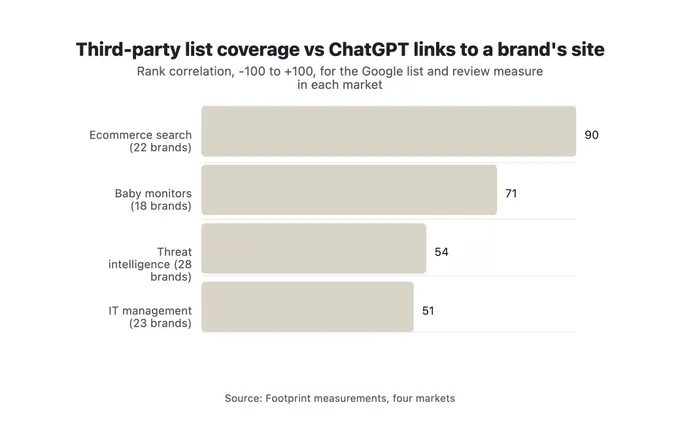
The measures are not identical. The ecommerce search, baby monitor and IT management rows count best-of, review or comparison pages that name the brand. The threat intelligence row counts Google results for early-research questions, such as explainers and lists. In the baby monitor market the other strong passers were YouTube engagement (+70) and Reddit upvotes on posts naming the brand (+64). Brand size measures in the baby monitor market were nowhere near significant: referring domains scored +5.
Where the pattern breaks
The table shows how many activities we tested and how many passed in each market with a published count, and what led the passers.
Market | Brands | Activities tested | Passed | What led |
|---|---|---|---|---|
Baby monitors | 18 | 46 | 16 | Best-of list mentions, +71 |
IT management | 23 | 47 | 15 | Pages that answer the searcher's question, +92 (8 brands analyzed) |
Pelvic floor trainers | 17 | 42 | 14 | Search traffic to pages that link to the brand, +79 |
Threat intelligence | 28 | 42 | 4 | Early-research Google results, +54 |
Shopify apps | 15 | 46 | 3 | None positive; all three passers were negative |
The exceptions matter as much as the pattern:
- Egnition's market. All three activities that passed ran negative: more backlinks (-62) and more Reddit posts (-52) went with a smaller share of ChatGPT's links. We read this as a feature of a small market, and not as a sign that links or Reddit hurt.
- Own-site rankings. The number of tracked keywords a brand's own site ranks for on Google scored +77 for kGoal and +73 for Atera, and +4 in the baby monitor market, where Babysense's site ranks for the most keywords of the 18 brands.
- Freshworks. It appears in 158 best-of and review results in the IT management market, the most of any brand, and holds 1.9% of ChatGPT's site links.
- Momcozy. Its own site held 29 page-one results in the baby monitor market, second to Babysense, and ChatGPT named it twice. Nanit's own site held five and ChatGPT named Nanit 59 times.
Larger brands tend to do more of everything and also get named more, so some of these links may reflect brand size rather than any one activity.
How to rank in ChatGPT: a five-step AI SEO plan
Ranking in ChatGPT comes down to two questions: does ChatGPT find a page that names you when it searches, and does it have a reason to link yours? Pages must still be crawlable and indexed; for Google's AI features that is all it requires. The steps below follow what tracked best in our data. For more on that engine, read how to get cited by ChatGPT in our ChatGPT citations guide.
Step 1: Check what ChatGPT says today
Ask ChatGPT, with web search on, your buyers' questions and record the brands and pages it names. The free AI visibility checker does a quick version of this.
Write the questions the way buyers type them. ChatGPT made Babysense its first pick for "non wifi baby monitor" and left it out of "best baby monitor without wifi", two phrasings of the same need. We ran each question once, so one answer cannot show whether the brand is reliably absent, but the pair shows why you check several wordings.
Step 2: Find the pages that rank for those questions
List the third-party pages that rank for your buyers' questions and see which brands they name. In the baby monitor market, Babysense appeared on 80 blog, review and comparison results to Nanit's 186. Those pages are the pitch list for the next step.
Step 3: Earn a place on the lists that rank
How to get cited by AI starts with the pages that rank. Of everything we tested, third-party list and review coverage was the most consistent lead (Chart 1). Pitch the pages that name your competitors and not you, offer data or a review unit, and say who you are. This is the work of digital PR and link building, done with attention to what each page already says.
Step 4: Show up where buyers talk
In the baby monitor market, Reddit upvotes on posts naming a brand (+64) and YouTube engagement (+70) both passed the test. One possible reason is that engines read threads and videos that rank for buyers' questions. Reply openly as a person from your company, and read each subreddit's rules first.
Step 5: Publish pages that answer the exact question
Own pages are the part of the plan you fully control. kGoal shows where they can fill a gap: ChatGPT named kGoal on all five feature questions and named Elitone on all five broad device questions, such as "pelvic floor trainer", where it never named kGoal. A page that answers a broad question in the words buyers use is a page of yours an engine could read; we have not tested whether it changes the answer.
How to show up in Google AI Overviews and AI Mode
Google's AI Overviews are the written answer above the results, and AI Mode is a separate way to search that answers in a thread of follow-up questions. Our guide to how to rank in Google AI Overviews has the full plan, and our Google AI Overviews study has the baby monitor data.
Google showed an AI Overview on 243 of 270 searches (90%). Nanit was named in 73 of them and Babysense in 61 (25%). Google linked Babysense's own site in 12 overviews, the most of the 18 tracked brands and twice Nanit's 6. Across the 18 brands, blog, review and comparison results naming a brand (+65) and the number of other websites on page one that name it (+61) passed the significance test for linked overviews. Ranking your own site (+56) did not pass.
Babysense held 14.6% of brand mentions in AI Overviews, second to Nanit. Weighted by each search's monthly volume, it fell to 3.5%, seventh, because the largest search, "best baby monitors" (110,000 of the 183,080 monthly searches tracked, 60%), has an overview that names five rivals and leaves Babysense out. For the biggest searches, get named in that one answer first.
Does AI SEO work the same on Gemini, Claude and Perplexity?
Do not assume so. Our correlation work covers ChatGPT and Google's AI Overviews, and engines differ even on the same questions. Chart 2 shows an example from our own measurement: 26 SEO content software questions, each asked three times on four engines.
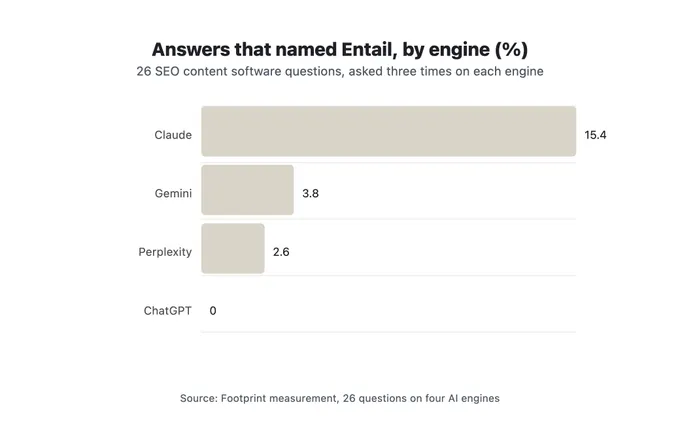
Claude named Entail in 12 of 78 answers, Gemini in 3 of 78, Perplexity in 2 of 77, and ChatGPT in none of 75. By our automatic count, every answer that named Entail was about keyword cannibalization (it was named on 8 of the 15 such questions and none of the other 11). The same pattern appears in baby monitors. ChatGPT gave Babysense 6.4% of brand mentions (17 of 267) and AI Overviews gave it 14.6% (70 of 481), and the two named it for the same question only five times.
What carries over is the basics: crawlable pages, coverage on third-party sites and measuring each engine separately. Our correlations cover ChatGPT and AI Overviews only.
How to optimize content for AI search
Once the outside pages are in motion, work on your own. The most-cited evidence we know of comes from the original paper on generative engine optimization, "GEO: Generative Engine Optimization" by Pranjal Aggarwal and five co-authors, accepted to the KDD data mining conference. The authors rewrote source pages with different methods and measured visibility in generated answers. Adding citations, quotations and statistics were among the best methods, with relative gains of up to 40% on the paper's main measure, in the authors' tests. Keyword stuffing gave little to no improvement.
These results come from the authors' test models and one benchmark, not live ChatGPT. They are still a reasonable starting point for page edits:
- Open with the answer. State the answer to the page's question in the first two or three sentences.
- Match the buyer's words. Use the phrasing your buyers type, as in the "non wifi" and "without wifi" pair above.
- Add sourced evidence. Include statistics with a named source, quotations from named people, and citations to the pages you rely on.
- Cover the comparison pages. Our site analysis of the baby monitor market found that none of the 18 brands had a comparison page. That is a gap and not a tested lead, because with no variation there was nothing to correlate.
- Skip keyword stuffing. It did not help in the paper's tests.
How to measure AI SEO
To measure AI SEO, pick a fixed set of buyer questions, ask each engine with web search on, record every mention and every cited page, and divide each brand's mentions by all brand mentions. Repeat monthly on the same questions, because a different question set breaks the comparison. Our guide to how to measure AI visibility walks through the setup.
What AI SEO is not
AI SEO is not a file or a tag, and it is not a guarantee. No engine publishes how it chooses brands, and the same question can produce different answers on different days, so treat each measurement as a snapshot.
Limits of our AI SEO data
- Six markets, one snapshot each. Each study covers one market on one day, mostly on ChatGPT, with its own question set, so we do not compare shares across them.
- Correlation is not cause. We tested 42 to 47 activities per market across 15 to 28 brands. About 5% of the activities tested would pass by chance, many measure related things, and brand size may explain some of it.
- Page one is a proxy. It shows what engines can read, and ChatGPT does not necessarily search Google.
- No customer result yet. We have not measured a customer result from any of this work. Our methodology page, listed in Sources, explains how the measurements are taken.
Frequently asked questions
What is AI SEO and how is it different from SEO?
AI SEO is the work of getting your website named and linked in the answers AI engines write. SEO earns a page a ranking in a list of links, and AI SEO gets a brand into the answer. They overlap because engines that search the web must find and read a page first, so SEO still matters.
How do I get my website mentioned by ChatGPT?
Check what ChatGPT says to your buyers' questions today, find the third-party pages that rank for them, and work on being named there. In our data, list and review coverage, YouTube engagement and Reddit upvotes tracked ChatGPT's links to brand sites. Then publish pages that answer the exact question.
Do I need an llms.txt file or special markup for AI SEO?
Not for Google. It says there are no additional requirements to appear in AI Overviews or AI Mode, and no AI text files or special structured data are needed. Pages must be indexed and eligible to show with a snippet. For other engines, see our guide to what llms.txt is.
Does AI SEO work?
The paper shows gains in a simulated engine, and our data shows tracked leads, but no customer has a measured result yet. The field is young, so treat each tactic as something to test and measure.
Why AI SEO reaches past your own site
AI SEO starts with your own pages and then reaches past them. In baby monitors, nine in ten page-one results belonged to someone else, and in four markets the brands with more list and review coverage had a larger share of ChatGPT's links to their own sites. The exceptions, Egnition's negative results and Freshworks' 158 list results with few links, are the reason to test each tactic in your own market.
Run the free AI visibility checker, then look at which third-party pages rank for the questions where an engine named a competitor instead of you. When you want help, our AI search optimization service works on the sources behind the answers in your market and tracks the same questions each month. To see where you stand, book a demo.
Sources
Footprint methodology. Measurements in baby monitors, ecommerce search, IT management, threat intelligence, Shopify apps, pelvic floor trainers and SEO content software.