Generative Engine Optimization (GEO): Definition and Data
Generative engine optimization (GEO) gets AI engines like ChatGPT to name your brand. See what GEO is, how it differs from SEO and what the data shows.


Updated November 11, 2026

In this article
What is generative engine optimization?
GEO vs SEO: how are they different?
Where did the term GEO come from?
What did the original GEO research find?
Show More
Generative engine optimization (GEO) is the work of getting your brand named and cited in the answers AI engines write: ChatGPT, Gemini, Claude, Perplexity, and Google's AI Overviews and AI Mode. In the baby monitor market we measured, brands owned about one result in ten on Google's first page for 135 searches, and engines that search the web can read the other nine.
This guide covers where the term came from, what the original research found, how GEO relates to SEO, and what our measurements show about where the work may pay off.
The examples come from Babysense, a baby monitor brand and Footprint customer that agreed to publish its data.
Key takeaways
- GEO means getting AI engines to name and cite your brand. The term comes from a paper by six researchers, accepted to the KDD data mining conference.
- In the paper's tests, adding citations, quotations and statistics raised visibility in generated answers by up to 40%. Keyword stuffing gave little to no improvement.
- On Google's page one for 135 baby monitor and nursery searches, the 18 tracked brands owned 10.6% of the results, and 94% of their 2,157 brand appearances were on other sites.
- Across 18 brands, best-of list mentions, YouTube engagement and Reddit upvotes tracked how much of ChatGPT's linking went to each brand's own site. The quality of the brands' own pages did not (a score that was not significant, from one measure across 18 brands). These are leads to test, not proven causes.
- Babysense ranked seventh in ChatGPT's brand mentions and second in Google's AI Overviews for the same searches, so each engine needs its own measurement.
What is generative engine optimization?
Generative engine optimization is the practice of increasing how often AI engines mention and cite a brand when they answer its buyers' questions. A search engine returns a list of links and the reader picks. A generative engine writes the answer itself and names the products it thinks fit, so a brand missing from the answer gets no visit from that reader.
Other names for GEO, including LLM optimization
You will also see GEO called AI SEO, generative SEO, answer engine optimization (AEO) or LLM optimization (LLMO). Usage varies and no body defines the terms, so the label matters less than the goal: being named in the answer. For how AEO differs, see AEO vs GEO vs SEO.
How does GEO work? How an AI engine builds an answer
With web search on, an engine typically:
- Turns the question into one or more searches.
- Reads a selection of the pages those searches return.
- Writes an answer that combines what it read with what it learned in training.
- Attaches source links to some passages.
A brand gets named when the pages the engine reads name it, or when the engine already knows it well from training. GEO works on both.
What GEO measures
The standard measure is AI share of voice: a brand's mentions divided by all brand mentions across a fixed set of buyer questions, per engine. A mention is a brand named in an answer. A cited mention is a mention with a source link in the same passage of the answer; the link can go to the brand's site or to a third-party page. A volume-weighted version counts each question by its monthly search volume.
To measure it yourself:
- Fix a set of buyer questions.
- Ask each engine those questions with web search on.
- Count the brand mentions and the cited mentions.
- Divide each brand's mentions by all brand mentions.
- Repeat monthly on the same questions.
See AI share of voice for the calculation and how to measure AI visibility for the setup.
GEO vs SEO: how are they different?
GEO builds on SEO, so SEO still matters: engines that search the web must find and read a page before they can use it. SEO earns your page a ranking, while GEO (sometimes written GEO SEO) gets your brand named in an AI engine's answer. See AEO vs GEO vs SEO for the full comparison.
Pages must be crawlable, indexed and eligible to show with a snippet. For Google's AI features, Google says nothing beyond that is needed: "There are no additional requirements to appear in AI Overviews or AI Mode, nor other special optimizations necessary." It adds that you don't need "new machine readable files, AI text files, or markup" (Google Search Central).
| SEO | GEO |
|---|---|---|
Goal | Your page ranks for a search | Your brand is named in the answer |
Measured by | Position of your page | Share of mentions that name you, per engine |
Pages that matter most | Your own | Yours and the third-party pages that rank |
Where it shows | Google and Bing results | ChatGPT, Gemini, Claude, Perplexity, AI Overviews, AI Mode |
Where did the term GEO come from?
The name comes from the paper "GEO: Generative Engine Optimization" by Pranjal Aggarwal, Vishvak Murahari, Tanmay Rajpurohit, Ashwin Kalyan, Karthik Narasimhan and Ameet Deshpande. It was first posted to arXiv and accepted to KDD, the ACM's data mining conference.
The authors started from a problem every marketer now feels: generative engines answer from many sources at once, and the people who write those sources have little say in how they appear. They proposed GEO as a fix and built a multi-domain benchmark, GEO-bench, to test it.
What did the original GEO research find?
The authors rewrote source pages with different methods and measured how visible each version became in the generated answer.
Citations, quotations and statistics beat keyword stuffing
In the paper's tests, adding citations, quotations and statistics were among the best methods, with relative gains of roughly 30% to 40% on the paper's main measure, a position-adjusted word count of how much of the answer draws on a page. Keyword stuffing, the old search trick, gave little to no improvement.
GEO results vary by subject
The best methods varied by domain. That suggests no single checklist fits every market (our reading). They also report tests on Perplexity, a live engine.
Lower-ranked pages gain the most from GEO
The Cite Sources method raised the visibility of sites ranked fifth in search by 115.1%, a relative change in visibility and not 115 percentage points. The top-ranked site's visibility fell by 30.3% on average. In the paper's tests, a generated answer did not follow the search ranking's order, which opened a gap for lower-ranked pages.
What the paper does not tell you
The results come from the authors' test models and one benchmark. They describe what worked in the authors' test setup, not what works on live ChatGPT today. Our own measurements below are a recent check, and they measure something different: which third-party activity tracks the engine's choices.
Who owns Google's page one? Mostly not the brand
Our measurement for Babysense shows how little of Google's page one the 18 tracked brands hold. Of 1,172 page-one results for 135 searches, they owned 124, or 10.6%.
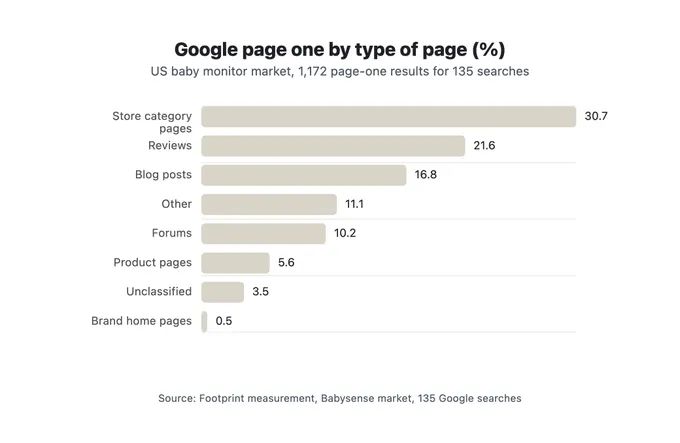
Store category pages, review pages and blog posts made up 69.1% of page one. Even Babysense, which owned more results than any other tracked brand, held only 38.
Raw counts understate how much some page types matter. Weighting each result by the monthly search volume of its search shifts the picture:
Page type | Share of page-one results | Share weighted by search volume |
|---|---|---|
Store category pages | 30.7% | 26.9% |
Reviews | 21.6% | 42.5% |
Blog posts | 16.8% | 17.6% |
Forums | 10.2% | 4.5% |
Reviews are 21.6% of results but 42.5% of the volume-weighted visibility. By site type, news sites are 9.4% of results and 32.6% weighted. Searches with large volume lean toward review and news pages.
Where brands get named
A page can name more than one brand, so the 2,157 brand appearances are more than the 1,172 results. Of them, 124 were on the brands' own ranking pages and 2,033 were on other sites. Chart 2 shows the six most-named of the 18 tracked brands.
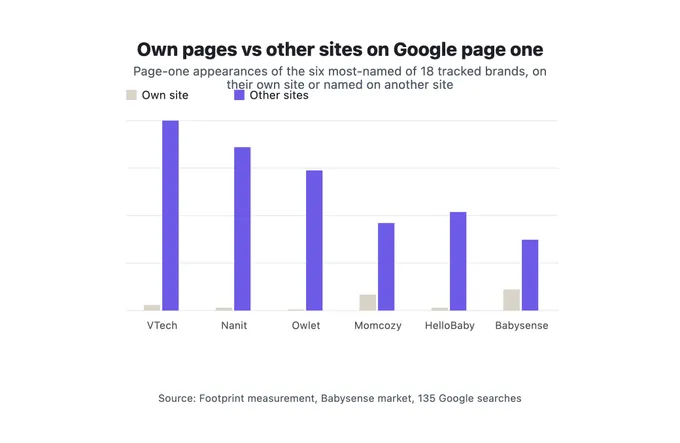
VTech, the brand named most on page one, appeared 343 times on other sites and 10 times on its own. Counted by brand appearances, only 5.7% (124 of 2,157) were on the brand's own site. A brand that publishes only on its own site works on the smaller share of what ranks.
Which GEO activities track ChatGPT's citations?
In the Babysense market, brands named on more best-of lists, discussed more on Reddit and watched more on YouTube were the ones whose own sites ChatGPT linked most (see how ChatGPT citations work). The quality score of their own pages did not follow the same pattern. These are correlations across 18 brands, so treat them as leads.
What we measured: own-site citation share
A brand's own-site citation share is the share of all tracked brands' ChatGPT citations that link to the brand's own website. ChatGPT gave 107 such citations in this market, and Nanit's site received 36 of them (33.6%). Babysense's received 6.
Which activities tracked ChatGPT citations
For each brand we counted dozens of activities, from best-of list mentions to Reddit upvotes, and measured how closely each followed own-site citation share with a Spearman rank correlation, reported from −100 to +100. The table covers 18 brands on ChatGPT. It shows 8 of the 46 activities tested, the strongest in each group plus two that did not pass.
Activity | Correlation (−100 to +100) | Statistically significant (p < 0.05) | Babysense | Highest in the market |
|---|---|---|---|---|
Mentions in best-of lists on Google | +71 | Yes | 80 | Nanit, 186 |
YouTube engagement | +70 | Yes | 7,463 | Owlet, 192,995 |
Mentions in editorial articles on Google | +66 | Yes | 72 | VTech, 172 |
Reddit upvotes on posts naming the brand | +64 | Yes | 2,930 | Owlet, 23,949 |
Average monthly search traffic to pages that link to the brand | +59 | Yes | 3 | Harbor, 108 |
Reddit mentions | +52 | Yes | 226 | VTech, 371 |
New quality links per month | +10 | No | 25 | eufy, 201 |
Content quality score of own pages | −38 | No | 44.7 | Harbor, 52.3 |
The content quality score had a negative correlation (−38) that was not significant, so it could be chance. It is a single score for 18 brands, so it is not evidence that page quality is irrelevant.
Larger brands tend to do more of everything and also get named more, so these links may reflect brand size rather than any one activity.
Exceptions to the pattern
Momcozy had almost exactly as many best-of list mentions as Babysense, and ChatGPT never linked its site. Cubo Ai had the second-highest YouTube engagement and only 5 of the 107 links. Each market needs its own table, which the Footprint signals report builds for your brand.
Why each AI engine needs its own number
Babysense ranked seventh in ChatGPT's brand mentions (17 mentions, a 6.4% share) and second in Google's AI Overviews (70 mentions, about a 14.6% share) for the same searches, behind Nanit. Seventh place was only 2 mentions behind sixth, eufy at 19. Gemini, Claude and Perplexity were not measured in this study. See the Babysense study for both engines.
How to do generative engine optimization
Each piece of GEO work should tie to something the next measurement can count:
- Best-of list placements on the review and "best X" pages that rank for your buyers' questions.
- [Reddit posts and comments](https://thefootprint.ai/services/reddit-marketing) in the communities that rank, written openly by people from the company.
- [Videos](https://thefootprint.ai/services/youtube-marketing) on your channel or with creators. YouTube engagement was one of our strongest leads (+70).
- [Links and mentions](https://thefootprint.ai/services/link-building-digital-pr) from pages that already get search traffic, which tracked ChatGPT's links here (+59). New link volume did not (+10).
- Pages worth citing: comparison, alternatives and answer pages.
- A [monthly measurement](https://thefootprint.ai/platform/how-it-works) on the same questions, per engine, with every mention and its cited page.
Earn best-of list placements
Best-of list mentions had the highest correlation in our table (+71). Find the lists that rank for your buyers' questions, see which brands they name, and work on being included. Treat that as a lead to test in your market.
Show up on Reddit and YouTube
Reddit upvotes (+64) and YouTube engagement (+70) both passed the significance test. One possible reason is that engines read threads and videos that rank for buyers' questions. Whatever the cause, upvotes and engagement are numbers you can count again next month.
Publish pages worth citing
Our site analysis for the same snapshot found that none of the 18 baby monitor brands had a comparison page. That is a gap, not a tested lead, because with no variation there was nothing to correlate. The paper's strongest page-level methods were adding sourced statistics, quotations from named sources and citations, so add those to the pages you want engines to read. Own-site citations were concentrated: Nanit's site received 36 of the 107, and Babysense's 6.
Measure monthly
Run the same questions every month so you can compare like with like. Pair each answer with the pages it cited. Changing the questions breaks the comparison.
What GEO is not
A file or a tag
For Google's AI features, a file or tag is not required: Google says they need no special schema.org structured data and no AI text files. Other engines publish their own guidance, which we have not reviewed. A GEO plan that is mostly markup is mostly SEO hygiene.
A blog rewrite
Better pages help, and in the paper's tests, evidence outperformed keywords. Yet in this market the brands' own pages were a tenth of Google's page one, so a rewrite alone addresses a small share of what ranks.
A guarantee
No engine publishes how it chooses brands, and the same question can produce different answers on different days. Treat each measurement as a snapshot.
Limits of our GEO data
- One market, one snapshot. The baby monitor figures cover Google's page one, ChatGPT and AI Overviews for 135 searches at the time of measurement. Some of those searches are about sound machines, night lights and other nursery products.
- Page one is a proxy. It shows what engines can read, and ChatGPT doesn't necessarily search Google.
- Correlation isn't cause. We tested 46 activities across 18 brands with a permutation test of up to 5,000 shuffles. Sixteen passed at p < 0.05, about two would pass by chance, and several measure related things, so they are leads worth testing.
- No customer result yet. We have not measured a customer result from any of this work. Our methodology page explains how the measurements are taken.
Frequently asked questions
Does GEO replace SEO?
No. Engines that search the web have to find and read a page before they can use it, so SEO still matters. SEO measures where your page ranks, and GEO measures whether an AI engine's answer names your brand. The pages that rank for those questions are mostly ones you don't own.
What is the difference between GEO and AEO?
Answer engine optimization (AEO) focuses on the page that answers a direct question, and GEO focuses on whether AI engines name your brand. The two overlap, and usage varies. Our guides to what AEO is and AEO vs GEO vs SEO compare them.
Do I need special markup or AI text files for GEO?
Not for Google. Google says there are no additional requirements to appear in AI Overviews or AI Mode, and no AI text files or special structured data. Pages must be indexed and eligible to show with a snippet.
How do I measure GEO?
Fix a set of buyer questions, ask each engine with web search on, and divide each brand's mentions by all brand mentions. Do it per engine and repeat monthly on the same questions. The measuring guide walks through the setup.
Does GEO work?
The paper shows gains in a simulated engine, and our data shows tracked leads, but no customer has a measured result yet. The field is young, so treat each tactic as something to test and measure.
Which AI engines does GEO cover?
GEO covers ChatGPT, Gemini, Claude, Perplexity, Google AI Overviews and AI Mode. They disagree about the same brand: Babysense was seventh on ChatGPT and second on AI Overviews for the same questions.
In baby monitors, most page one results belong to other sites
GEO started as a research question about making one page more visible in generated answers, and the paper's answer was evidence. Our measurements add a market view. In baby monitors, nine in ten page-one results belonged to someone else. Across 18 brands, best-of list mentions, YouTube engagement and Reddit upvotes tracked ChatGPT's links to brand sites; they are leads to test, not proven causes.
Run the free AI visibility checker, then look at which third-party pages rank for the questions where an engine named a competitor instead of you. When you want to work on it, our generative engine optimization services measures the sources behind the answers in your market and tracks the same questions each month. To see yours, book a demo.
Sources
Footprint methodology. Babysense market measurement, 135 questions on ChatGPT and Google AI Overviews and 135 Google searches.