Best AI SEO Agencies: 9 Compared on Price and Method
The best AI SEO agencies compared: 9 AEO and GEO providers on published price, engines and how each measures results, plus 8 questions to ask.


Updated November 11, 2026

In this article
How we chose and ordered these agencies
The best AI SEO agencies compared: price, engines and method
1. First Page Sage: best for list-article placement
2. Omniscient Digital: best for B2B software with a large budget
Show More
This guide to the best AI SEO agencies compares eight agencies and Footprint, our own product. Only two of the eight, Omniscient Digital and First Page Sage, publish a price. The rest quote privately, so the comparison that matters is how each says it will measure you in AI answers, and where beyond your own site it works.
AI SEO is the work of getting AI engines such as ChatGPT, Perplexity, Gemini, Claude and Google AI Overviews to name your brand when a buyer asks a direct question. An AI SEO agency, an AEO agency (answer engine optimization) and a GEO agency (generative engine optimization) sell the same service under different names, and some also call it AI search optimization. The table below draws on each agency's own service page, as listed at the time of writing, and the eight questions after it are the ones to ask on the first call.
Key takeaways
- Omniscient Digital starts at $120,000 a year. First Page Sage lists $6,000 to $12,000 a month ($72,000 to $144,000 a year) in its own pricing report.
- Six of the eight agencies list the AI engines they work on. NoGood and Victorious name seven each.
- Six of the eight list at least one activity on sites you don't own, such as digital PR, Reddit, list articles or reviews. Directive and Victorious state none.
- Footprint is our product and offers this work too. We list it last and hold it to the same eight questions.
How we chose and ordered these agencies
Other agencies sell this work; these are the eight we could verify from a public AI SEO, AEO or GEO service page at the time of writing, and the list is not exhaustive. For each, we recorded the engines it covers, how it measures, what it ships, what it costs and how long it asks you to commit. We treat AI SEO services, AEO and generative engine optimization services as one service, since every agency here sells them under one name. Our AEO vs GEO vs SEO guide covers where the terms differ.
The ranking rule
The order is not a quality ranking. Agencies that publish a price come first, because a reader can check a price. The rest follow in alphabetical order. Footprint would sit second among the unpriced providers alphabetically; we put it last instead.
What this list can't show
This is a research-only comparison. We did not hire these agencies and did not verify their case-study results, which are quoted as each agency words them. A page shows how an agency describes its method, not whether the work moved anyone's share of voice.
Our Babysense figures in the questions section come from one measurement on one date, covering ChatGPT and Google AI Overviews. The correlations there describe 18 brands at one moment and don't show cause.
New to the term? Start with what answer engine optimization is.
The best AI SEO agencies compared: price, engines and method
The agencies differ most on price disclosure and measurement. Only Omniscient Digital (from $120,000 a year) and First Page Sage ($6,000 to $12,000 a month) publish a price. Seven of the eight state how they measure results; First Page Sage does not. Footprint, our product, is listed last.
Agency | Published price | Term | Engines named on its page | How it says it measures | Work beyond your own site |
|---|---|---|---|---|---|
First Page Sage | $6,000 to $12,000 a month ($72,000 to $144,000 a year) | Month to month | ChatGPT, Gemini, Perplexity, Claude, Google SGE | Not stated | List articles, reviews, awards |
Omniscient Digital | From $120,000 a year | Not stated | ChatGPT, Claude, Gemini | Visibility across prompt clusters, tied to CRM data | Original research, digital PR |
Directive | Not published | Not stated | ChatGPT, Claude, Perplexity, Bing Copilot, Google SGE | Citation tracking and dashboards | Not stated |
Graphite | Not published | Not stated | ChatGPT, Claude, Perplexity, Gemini, AI Overviews | Fixed quarterly query set, plus manual tracking | Reddit, offsite strategy |
iPullRank | Not published | Not stated | Not named in the service text | Citation frequency and AI referral traffic | Digital PR |
NoGood | Not published | Not stated | ChatGPT, Gemini, Claude, Perplexity, AI Overviews, AI Mode, Copilot | Citation rate, share of voice, sentiment | Digital PR, social |
Siege Media | Not published | Asks for a 6+ month horizon | None as targets (ChatGPT, AI Overviews mentioned in case studies) | LLM share of voice, monthly | Digital PR, Reddit, affiliate placements |
Victorious | Not published | 90-day sprints | ChatGPT, Claude, AI Overviews, AI Mode, Gemini, Perplexity, Copilot | Ongoing prompt testing | Not stated |
Footprint | Not published | Not stated | ChatGPT, Gemini, Claude, Perplexity, AI Overviews | Share of voice per engine, cited pages, tested activities | Reddit, YouTube, links, LinkedIn |
Every row comes from the agency's own AEO or GEO service page, as retrieved at the time of writing; the Footprint row describes our own product. First Page Sage's price comes from a separate pricing report, not its service page, and is a vendor claim. "Google SGE" is Google's former name for AI Overviews; the table keeps each agency's own word. The two published prices compare directly once annualized: $72,000 to $144,000 a year for First Page Sage against $120,000 and up for Omniscient Digital.
Who each agency suits, going by the table:
- Largest budget and CRM reporting: Omniscient Digital.
- Work on third-party sites: Siege Media and First Page Sage.
- Most engines named: NoGood and Victorious.
- Fixed 90-day sprints: Victorious.
1. First Page Sage: best for list-article placement
First Page Sage calls getting into list articles "the largest factor" in its GEO service.
What it does: list-article placement, inclusion in databases that AI models train on, website authority, review management, publicizing awards and social sentiment monitoring.
How it measures: the service page doesn't say.
Best for: a brand whose category answers are decided by "best X" lists.
Pricing: $6,000 to $12,000 a month, month to month, according to First Page Sage's own GEO and AEO pricing report.
Claimed result (agency's own): no case result on the service page. Service page: First Page Sage GEO services.
2. Omniscient Digital: best for B2B software with a large budget
Omniscient Digital publishes the clearest price on this list: "Full-service engagements start at $120,000/year."
What it does: buyer demand modeling, "source shaping" through original research, digital PR and third-party mentions, technical foundations and citation studies.
How it measures: it tracks "visibility and recommendation patterns across the prompt clusters that matter" and ties them to analytics, self-reported attribution and CRM data.
Best for: a B2B software company that wants AI visibility tied to CRM data.
Pricing: from $120,000 a year.
Claimed result (agency's own): "Convert grew LLM visibility 81% and AI citations 140%." Source: Omniscient Digital's AEO service page.
3. Directive: best for B2B pipeline reporting
Directive sells GEO under its DiscoverabilityOS method, run on its Stratos platform.
What it does: entity and topic mapping, AI content optimization, structured data and reporting tied to pipeline.
How it measures: "citation tracking, branded impression monitoring, and interaction modeling," with dashboards of citations, impressions and engagement from generative engines.
Best for: a team that wants AI citations and impressions in the same dashboards as pipeline.
Pricing: not published.
Claimed result (agency's own): Case Status went from no LLM presence to "dominant" across 39+ tracked prompts. Source: Directive's GEO service page.
4. Graphite: best for an auditable prompt set
Graphite tracks a fixed set of "200+ queries per quarter," built from sales calls, Reddit and help-center questions.
What it does: citation-ready content, brand sentiment and reputation, technical AEO, and offsite and Reddit strategy.
How it measures: the fixed query set plus manual, logged-in checks, because "Logged-out tracking tools only tell part of the story."
Best for: a software company that wants the same questions measured every quarter, so before and after compare cleanly.
Pricing: not published.
Claimed result (agency's own): Webflow saw "2x sign-ups from LLMs." Source: Graphite's AEO service page.
5. iPullRank: best for a program sized to your stage
iPullRank sells GEO in three tiers, aimed at startups, mid-market challengers and Fortune 500 category leaders.
What it does: an "AI Search visibility baseline," prompt strategy, "Cross-platform visibility measurement," content engineering, digital PR and executive reporting tied to revenue.
How it measures: "How often you're showing up inside AI answers" and AI referral traffic, with competitor benchmarking over time. The service text doesn't name engines, so ask which ones.
Best for: a company that wants to pick a tier by its stage: startup, mid-market or Fortune 500.
Pricing: not published.
Claimed result (agency's own): no case result on the service page. Source: iPullRank's GEO service page.
6. NoGood: best for reporting on every major engine
NoGood names seven engines, tied with Victorious for the most here: ChatGPT, Gemini, Claude, Perplexity, Google AI Overviews, Google AI Mode and Copilot.
What it does: an LLM visibility audit, prompt research, digital PR, social citation strategy, schema and agentic commerce work.
How it measures: "citation rate," "share of voice versus competitors" and sentiment, with AI referral traffic in GA4. Monitoring runs on its partner platform, Goodie AI.
Best for: a startup or scaleup that wants share of voice reported engine by engine.
Pricing: not published.
Claimed result (agency's own): SteelSeries saw 23x AI search traffic year over year. Source: NoGood's AEO service page.
7. Siege Media: best for work on third-party sites
Siege Media puts most of its GEO service on pages you don't own.
What it does: research reports and digital PR, comparison content, Reddit and community presence ("No fake accounts. No shortcuts."), and affiliate placements on sites such as Bankrate, Wirecutter and G2.
How it measures: "LLM share of voice" monthly, plus citations earned and AI referral traffic.
Best for: a SaaS, fintech or ecommerce brand already investing in content, willing to give it the "6+ month horizon" Siege asks for.
Pricing: not published.
Claimed result (agency's own): Grow Therapy saw "nearly 4x its LLM visibility." Source: Siege Media's GEO service page.
8. Victorious: best for 90-day sprints on your own site
Victorious focuses on your own site, in 90-day sprints with monthly reporting.
What it does: audit and strategy, technical optimization, query research, formatting for extraction (questions and answers, tables, summaries) and structured data.
How it measures: "ongoing prompt testing," with AI Overview citations as the headline metric in its case studies.
Best for: a team that wants fixed 90-day sprints with monthly reporting.
Pricing: not published; "priced against your site size."
Claimed result (agency's own): its case studies lead with AI Overview citations; we did not carry a figure over. Source: Victorious's GEO service page.
9. Footprint: best for measured work across channels
Footprint is our product, so read this entry with that in mind.
What it does: the Footprint team ships a monthly budgeted roadmap of Reddit posts and comments, YouTube videos, links and digital PR, LinkedIn posts and new pages. It also runs a one-off AI visibility audit.
How it measures: share of voice on ChatGPT, Gemini, Claude, Perplexity and Google AI Overviews, plus about 50 activities counted for you and every competitor and tested against your market; 46 had data for Babysense's market (how Footprint tests each signal).
Best for: a brand or an agency that wants the measurement and the work from one team, with the reason for each piece of work shown.
Pricing: not published. See Footprint pricing and Footprint's answer engine optimization service.
Claimed result (agency's own): none. Our customer measurements describe a market at one date, not a before-and-after change.
How to choose an AI SEO agency: eight questions to ask
These questions reflect how we measure, so Footprint is built to answer all eight; weigh them with that in mind. The examples come from our measurement for Babysense, a baby monitor brand and a Footprint customer that agreed to publish its numbers. In our measurement we asked ChatGPT 135 buyer questions built from Babysense's keyword list, ran 270 Google searches for the same market, the 135 keywords plus the 135 questions, and Google showed an AI Overview on 243 of them. We tracked 18 brands.
1. What is my share of voice today, per engine, and out of how many answers?
Ask for a number and its basis. Share of voice is a brand's mentions divided by all brand mentions, where a mention is a brand named in an answer. In Babysense's market, ChatGPT's 135 answers named brands 267 times: Babysense 17 times (6.4%) and the leader, Nanit, 59 times (22.1%). Our guide to how to measure AI visibility explains the method, and AI share of voice shows how Footprint reports it.
2. Which engines do you ask?
Ask for every engine your buyers use, because the engines disagree. On ChatGPT's 135 questions, Babysense was seventh of 18 brands by mentions (6.4%). In the 243 Google AI Overviews recorded for the same market, it was named in 61, second to Nanit with 73. An agency that tracks one engine reports only one of those positions. See also how ChatGPT picks its citations and how to rank in Google AI Overviews. See the full Babysense share of voice study and the AI Overviews study.
3. Where do the answers in my category come from?
Ask which pages and sites the engines cite for your category before agreeing on work, because a plan for your own site only fits when the answers cite it. One place to start is how often a brand's mentions sit in an answer passage that also links to the brand's own site, which we call a site-linked mention.
Among the seven brands ChatGPT named most, each with 17 or more mentions, the site-linked share ran from 17% for Owlet (7 of 42 mentions) to 79% for eufy (15 of 19). Nanit had 36 of 59, Infant Optics 9 of 20, Babysense 6 of 17, Miku 8 of 24 and VTech 5 of 28. Because eufy's 79% rests on only 19 mentions, read the bars as a pattern rather than a precise ranking.
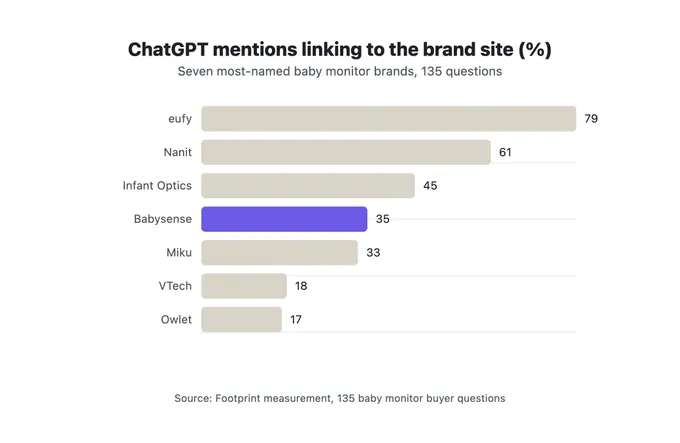
A brand with few site-linked mentions may be named from what the model already knows, or from third-party pages. A brand with many suggests ChatGPT is pointing to its site.
4. Why this work, and not something else?
Ask the agency to show evidence from your market for each activity it proposes. For Babysense we correlated 46 activities with each brand's site-link share, its share of all site-linked mentions. Sixteen passed a permutation test at p < 0.05, against about 2 that would pass by chance. These led the list, on a Spearman scale of −100 to +100:
- Blog, review and comparison pages on Google that mention it: +71. Babysense appears on 80 such pages, Nanit on 186.
- Likes and comments on other channels' YouTube videos that mention it: +70. Owlet has the most (192,995 likes and comments).
- Upvotes on Reddit posts that mention it: +64. Owlet has the most upvotes (23,949).
Many of the 16 overlap, so they are best read as a few related patterns, and any single one could be luck. We call them leads worth testing. One counterexample: Babysense's own-site rankings, the best in the market, scored only +4. Ask for evidence like this for your own market, because "it works for our other clients" is only an opinion.
5. What does the agency do with activities that don't pass the test?
Ask whether the agency keeps testing them. New quality links a month scored +10 in that market and did not pass the test. That means the activity is not shown to matter there, but 18 brands is a small sample, so a good agency neither drops it for good nor funds it on faith. Ask how often the plan is revisited.
6. What will it cost, and where should my number be at the end?
Ask for a monthly price next to the share of voice the agency expects, including the case where the budget isn't enough to catch the brand ahead of you. A plan that only promises "visibility" leaves you without a target to check. Only two of the eight agencies here publish any price, so a number tied to a target is the only way to compare quotes.
7. Who does the work, and where?
Ask who writes the pages, who posts on Reddit and in which communities, whether videos go on your channel or through creators, and where links come from. Footprint's own services in this area are Reddit marketing, YouTube marketing and link building and digital PR. An agency that only works on your site may fall short where, as in question 3, several brands are named with few links to their own sites.
8. How will you show me it worked?
Ask for the same questions, on the same engines, in a new dated measurement, with share of voice per engine next to the last one. A new question set makes before and after impossible to compare, so ask what changes if the number didn't move.
Red flags on the first call
Treat any of these as a reason to pause before signing:
- A monthly report that lists deliverables and no share of voice.
- Results claimed without a time frame, a baseline or a method.
- A plan written before anyone measured your market.
Frequently asked questions
How much does an AI SEO agency cost?
Published prices range from $6,000 a month to $120,000 a year; the other six agencies here quote privately. Omniscient Digital publishes a floor of $120,000 a year. A vendor report from First Page Sage puts the median GEO and AEO retainer across agencies at $6,850 a month; its own range is $6,000 to $12,000.
What should an AEO agency deliver each month?
An AEO agency should deliver a measured share of voice per engine, the questions and answers behind that number, and a list of what it shipped and where. The profiles above describe monthly share of voice reporting (Siege Media), monthly reporting in 90-day sprints (Victorious) and dashboards of citations and impressions (Directive).
Should I hire an AI SEO agency or use a tool?
Use a tool if your team has writers, a community manager and someone who earns links, and only needs the number. Hire an AI search optimization agency, or a tool with a team that ships the work, if nobody has the hours. Only two of the eight agencies here publish a price, so expect a quote. Our AI visibility tools comparison and GEO tools comparison cover the tool side.
How long does AI SEO take to show results?
AI SEO takes months, and most agencies state no horizon. Siege Media asks for six or more, Victorious works in 90-day sprints and First Page Sage sells month to month; the other five state none. Get a dated baseline before any work starts, so you can judge the change on the same questions.
Two of eight agencies publish a price, so compare the rest on how they measure
Price is public for two of the eight agencies, so compare the rest on how they answer the eight questions above. Omniscient Digital and First Page Sage are the easiest to budget for, and six of the eight describe work on sites you don't own.
Get a dated baseline, for example from Footprint's free AI visibility checker, and give every agency the same questions. To hear how we answer all eight on your brand, book a demo.
Sources
First Page Sage, GEO services and GEO and AEO pricing report (vendor research).
Footprint methodology. Measurement of ChatGPT and Google AI Overviews for Babysense, 135 baby monitor questions and keywords.
Babysense share of voice study and Babysense in Google AI Overviews, Footprint.