llms.txt: What It Is and Whether It Helps AI Visibility
llms.txt is a proposed Markdown file that points AI tools to your best pages. See the format, who reads it, how to create one and whether it helps.


Updated November 11, 2026
In this article
What is llms.txt?
How is an llms.txt file structured?
What does an llms.txt example look like?
Who actually reads llms.txt?
Show More
llms.txt is a proposed plain-text file, written in Markdown and placed on your website, that gives AI tools a short, curated list of your most useful pages. It is a proposal, not an internet standard, and no major AI engine has confirmed that it reads the file when it writes answers. Google's John Mueller said that Google doesn't use it, so for most brands it is a low-cost extra, not a way to appear in ChatGPT.
This guide covers what an llms.txt file contains, a worked llms.txt example, what we could verify about who reads it, how to create one with an llms.txt generator or by hand, and what to do first if your goal is to be named in AI answers.
Key takeaways
- llms.txt is a Markdown file at the root of a site, proposed on llmstxt.org, that lists curated links with short notes for AI tools. Only a title (an H1) is required.
- Google says it doesn't use llms.txt, and that it needs no "AI text files" for AI Overviews or AI Mode. We found no statement from OpenAI, Anthropic or Perplexity that their crawlers read it to build answers.
- Ahrefs studied 137,000 domains: 28% had a valid file, and 97% of those received zero requests for it in the month measured. This is vendor research on one sample.
- OpenAI, Anthropic and Perplexity each publish an llms.txt for their own documentation (OpenAI, Anthropic, Perplexity), which shows the file is useful for developer docs, not that their engines read yours.
- Creating the file is quick, so it is fine as housekeeping. Put the real effort into the pages and third-party mentions that AI engines actually read, and measure them.
What is llms.txt?
llms.txt is a file named llms.txt, served from your website's root (for example, yoursite.com/llms.txt), that summarizes the site and links to its most important pages in a format that is easy for a language model to read. The llmstxt.org proposal describes its purpose this way: "Agents are best served by concise, expert-level information gathered in a single, accessible location."
The idea addresses a real constraint. A web page is full of navigation, scripts and layout that a model has to read past, and a model can only hold so much text at once. A short file that says what the site is and where the good pages live saves that work. The proposal was written by Jeremy Howard of Answer.AI. Some sites add a companion llms-full.txt that holds the content itself: Anthropic's llms.txt ends with a pointer to its llms-full.txt, and OpenAI's index lists a single-file Markdown export of its API docs (Anthropic's file, OpenAI's file).
How is llms.txt different from robots.txt and sitemap.xml?
Each file has a different job, and llms.txt does not replace either of the others.
File | Audience | What it does | Status |
|---|---|---|---|
robots.txt | Crawlers | Allows or blocks access to URLs | Long-established; AI companies document how their bots follow it |
sitemap.xml | Search engines | Lists every URL you want crawled | Long-established; Google reads it |
llms.txt | AI tools and agents | Offers a short, curated guide to your best pages | Proposed; no major engine confirms using it for answers |
The key difference is control. robots.txt can stop a bot from fetching a page, and OpenAI documents that sites opted out of its search bot "will not be shown in ChatGPT search answers." llms.txt has no such enforcement. It suggests, and a reader is free to ignore it.
How is an llms.txt file structured?
The proposal specifies a small set of parts in a fixed order, and only the first is required.
- An H1 with the name of the site or project. This is the only required part.
- A blockquote with a short summary of the site.
- Optional detail, in any Markdown form except headings, for notes an AI tool needs to interpret the links.
- Zero or more H2 sections of links. Each item is a Markdown link, optionally followed by a colon and a note.
By convention, an H2 section named "Optional" holds secondary links that a tool can skip when it needs a shorter context.
The proposal also suggests that pages with useful information offer a clean Markdown copy at the same address, either by adding .md to the URL or by replacing the file extension with .md. A page at yoursite.com/guide.html would also be available at yoursite.com/guide.html.md. A llms.txt file can work without these copies, but the links then point to ordinary web pages.
What does an llms.txt example look like?
Here is the shape of a file for a fictional project management company, one line per part. The full file is plain Markdown, so you can build it in any text editor.
Part | What you write | What the line looks like |
|---|---|---|
H1 | The site name | # Acme Projects |
Blockquote | One or two sentences on what the site is and who it serves | > Acme Projects is project management software for small design agencies. |
Detail paragraph | Anything a reader needs before using the links | Pricing is per seat per month. The help center covers setup. |
H2: Product | Links with one-line notes | ## Product, then Features (link): what the tool does |
H2: Docs | Links with one-line notes | ## Docs, then Getting started (link): first project in ten minutes |
H2: Optional | Secondary links | ## Optional, then Changelog (link): product updates |
A real file follows the same pattern. Ours at thefootprint.ai/llms.txt opens with the name Footprint, a blockquote that describes what we measure, a paragraph on how the product works, and then H2 sections for Product and Services whose links each carry a one-line note. We also publish a plain-language AI instructions page for people and AI assistants that want to describe us accurately.
Writing good notes for each link
A link without a note makes the reader guess what is behind it. A good note says what the page answers: "Pricing: plans, seat limits and what each includes" is more useful to a model than "Pricing". Keep each note to one line, and describe the page as it exists today.
What to leave out
Leave out pages you would not want quoted: staging pages, thin tag archives, expired offers. Leave out claims you could not defend if an AI tool repeated them as fact, since the summary in the blockquote is likely to be the first thing a reader takes. The file should read as an accurate map, not as advertising copy.
Who actually reads llms.txt?
We could verify only a narrow answer: some tools and developers use the file, and none of the major AI engines has said that it uses the file to decide which brands to name. We checked what each company publishes and what Google has said.
Google has addressed this directly, in two ways. Its documentation for AI features says: "There are no additional requirements to appear in AI Overviews or AI Mode, nor other special optimizations necessary," and that "You don't need to create new machine readable files, AI text files, or markup to appear in these features" (Google Search Central). The page does not name llms.txt, but a file of this kind most plausibly falls under its "AI text files" wording; that is our reading, and Mueller's posts below address llms.txt by name.
Google's John Mueller has been more specific. In a Bluesky post, he wrote, "FWIW no AI system currently uses llms.txt." In a Reddit reply, he wrote, "Google doesn't use llms.txt or llms-author.txt," and added, "I don't know of any other crawler / llm confirming they're using these (other than SEO tools)" (reported by Search Engine Journal). When asked on Bluesky whether the llms.txt file on Google's ai.google.dev site was an endorsement, he answered no, and the report says the Search team removed the file from its own docs (Search Engine Roundtable). These are one person's public statements, not a formal policy document, but they are consistent.
OpenAI, Anthropic and Perplexity
We found no statement from any of these three that their crawlers or assistants read llms.txt files from other sites to build answers. What each one does publish is useful context:
- OpenAI documents three bots: OAI-SearchBot is used for ChatGPT search, GPTBot for content that may be used in training, and ChatGPT-User for actions a person starts in ChatGPT. The page says the search and training settings are independent of each other; robots.txt rules may not apply to ChatGPT-User fetches. The page mentions llms.txt once, as a link to OpenAI's own documentation index (OpenAI bots documentation).
- Anthropic publishes an llms.txt for its developer documentation, an index of Markdown pages with short descriptions (Anthropic's file). That shows Anthropic offers the format to developers. It does not say that Claude reads other sites' files.
- Perplexity documents PerplexityBot and Perplexity-User and says to manage PerplexityBot through robots.txt, and that Perplexity-User, which handles user requests, generally ignores robots.txt rules. Its page mentions llms.txt only as a pointer to its own documentation index (Perplexity crawlers documentation). Some third-party sites claim Perplexity supports the file, but we could not find a primary statement, so we treat that as unverified.
The pattern is the same across all three: robots.txt is the documented control, and each company uses llms.txt for its own developer docs. A developer pasting your llms.txt into a coding assistant is a real use. An engine consulting it before it names a brand is something we could not confirm.
What the one large study found
Ahrefs, an SEO software vendor, studied 137,000 domains in its web analytics. It found that 28% (38,360 domains) published a valid llms.txt file, and that 97% of those domains received zero requests for the file, from bots or people, in the month it measured. Ahrefs notes that its sample probably skews toward tech-savvy site owners, so adoption across the whole web is likely lower. It also says it found no evidence that llms.txt improves AI retrieval, traffic or the accuracy of answers (Ahrefs).
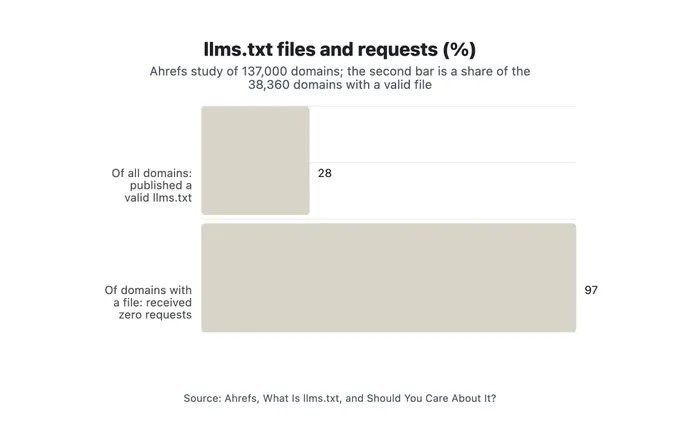
Read this as a sign of how rarely the file is fetched, not as proof that no AI tool ever uses it. A request count shows fetches of the file, and it can't tell you what a model did with the information. It is also vendor research on one sample, so treat the numbers as a single data point.
Does llms.txt help AI visibility?
We found no evidence that it does, and several reasons to expect little effect. The question has two parts: whether an engine reads the file, and whether reading it would change which brands the engine names.
On the first part, the verified statements point away from it. The other three companies publish robots.txt controls and no llms.txt crawling policy. On the second part, a file you write yourself is a self-description. Nothing stops a site from describing itself in the most flattering way, so an engine that trusted the file blindly would be easy to game. That is our reasoning, not a statement from any engine.
What does drive which brands get named?
The evidence we have is about the pages AI engines read, not about files. In our measurements, engines that search the web turn a question into searches, read a selection of the results, and write an answer, so a brand gets named when the pages they read name it. In the baby monitor market we measured, brands owned about one result in ten on Google's first page (our methodology), which means most of what an engine could read belonged to other sites. Our guide to generative engine optimization covers that data and the tracked activities, and how ChatGPT chooses its sources explains the citation side.
If you want to improve your odds of being named, three things have more support than a root-level file:
- Pages worth citing. Clear comparison, alternatives and answer pages, with sourced facts.
- Third-party mentions. Review sites, best-of lists, Reddit threads and videos that rank for your buyers' questions.
- Measurement. The same questions, asked each month on each engine, with every mention counted.
Is llms.txt worth it for Google AI Overviews?
No effect is documented. Beyond the standard Search technical requirements, Google says pages need to be indexed and eligible to show a snippet, and that meeting them does not guarantee inclusion. Our guide to ranking in Google AI Overviews covers what Google does say.
Where llms.txt can still be worth the time
A short, curated file can help in a few places even without engine support:
- Developer documentation. Tools that fetch docs for coding assistants can use an index of clean Markdown pages. This is a use the proposal describes, and the one where the AI companies publish their own files.
- Agent and tool workflows. A person who points an AI tool at your site gets a faster start when there is a map to follow.
- A forcing function. Writing the file makes you decide which pages matter most, which is a useful exercise before any optimization work.
How do you create an llms.txt file?
You can write one by hand, or use an llms.txt generator to draft it from your sitemap. Either way, review the result, because the quality of the file is the quality of its notes.
Create llms.txt by hand
- Pick the pages. Choose the pages that explain what you do: product, pricing, documentation, your best guides.
- Write the H1 and blockquote. Name the site, then describe it in one or two plain sentences.
- Group links under H2 headings. Use headings such as Product, Docs and Guides, and add a one-line note to every link.
- Move secondary links under an H2 named Optional.
- Save the file as llms.txt and upload it to your site root, so it loads at yoursite.com/llms.txt.
- Check it. Open the address in a browser, confirm every link works, and confirm each linked page is one you want quoted.
Use an llms.txt generator
An llms.txt generator reads your sitemap or pages and drafts the file for you. A generator saves the typing, but it can't judge which pages matter or write an accurate summary of your business. Treat its output as a first draft, then edit the notes and delete anything you would not want repeated.
Entail, the company behind Footprint, builds llms.txt files for its content clients from their sitemaps. We have not measured whether those files change what AI engines say, and we make no claim about results.
Keep the file current
A stale file can send a reader to dead pages or outdated prices. Review it whenever you change navigation, retire a product or move a section, and check the links on a schedule.
Common llms.txt mistakes to avoid
Treating llms.txt as a ranking tool
Do not expect a file to move your position or your mentions on its own.
Putting the file in the wrong place
The proposal allows the file at the site root or at a subpath, but a subpath file only covers its own subtree. A file buried in a folder no one links to will not be found by any tool that looks for it at the root.
Blocking AI bots and then publishing llms.txt
If your robots.txt blocks a bot, a polished llms.txt will not change that. Decide your policy for each bot first: OpenAI, for instance, has separate settings for its search bot (OAI-SearchBot) and its training bot (GPTBot); its user-triggered ChatGPT-User fetches work differently, and robots.txt rules may not apply to them. Then check with the free AI visibility checker whether engines name you at all.
Stuffing the file with keywords
The file is meant to be read, not ranked. Keyword lists add noise, and a claim that is wrong will be repeated wherever the file is used.
Frequently asked questions
What is llms.txt?
llms.txt is a proposed Markdown file, placed at a website's root, that gives AI tools a short list of the site's most useful pages with a one-line note on each. It was proposed at llmstxt.org and requires only an H1 with the site name. It is not an official internet standard.
Do ChatGPT, Claude, Gemini or Perplexity read llms.txt?
We could not verify that any of them do when answering questions. Google says it doesn't use llms.txt, and we found no statement from OpenAI, Anthropic or Perplexity that their crawlers read it. All three publish an llms.txt for their own documentation, which is a different thing.
Does llms.txt improve AI visibility or SEO?
There is no verified evidence that it does. Google says AI Overviews and AI Mode need no additional files, and Ahrefs found that 97% of the valid files in its sample received no requests. It is cheap to add, so treat it as housekeeping and measure your AI visibility separately.
How do I create an llms.txt file?
Write an H1 with your site name, a short blockquote summary, and H2 sections of links with one-line notes. Save it as llms.txt, upload it to your site root and check that every link works. An llms.txt generator can draft it from your sitemap, but you should edit the result.
For most brands, llms.txt is housekeeping, not a visibility strategy
The file is a reasonable idea that has not been shown to do what many guides promise. Google says it doesn't use it, three major AI companies document robots.txt for their bots and publish llms.txt only for their own docs, and the one large study we found showed most valid files receiving no requests. Having one costs little, and it can help developers and agent workflows.
What puts a brand in an AI answer is what the engine reads: your pages and, more often, other people's pages about you. Start by finding out whether engines name you today. Run the free AI visibility checker, and look at which pages rank for the questions where a competitor was named instead. When you want to work on it, our AI search optimization service measures the sources behind the answers in your market and tracks the same questions each month. To see yours, book a demo. For the wider topic, see our AI SEO guide and what answer engine optimization is.
Sources
Ahrefs, "What Is llms.txt, and Should You Care About It?", vendor research.