Answer Engine Optimization (AEO): What It Is, How It Works
Answer engine optimization (AEO) is AI search optimization that gets engines to name you. How engines pick sources and what 135 buyer questions show.


Updated November 11, 2026
In this article
What is answer engine optimization?
What does answer engine optimization cover?
How do answer engines choose what to cite?
What the Babysense measurement shows
Show More
Answer engine optimization (AEO), also called AI search optimization, is the work of getting AI engines such as ChatGPT, Perplexity, Claude, Gemini and Google's AI Overviews to name your brand when someone asks them a direct question. Instead of a list of links, an answer engine returns one written reply with a few brand names in it. AEO covers the questions buyers ask, the pages that answer them, the outside mentions that back them up and the measurement of all three.
The gap between ranking and being named shows up in our data. Babysense's website holds 38 of the 1,172 page-one positions for baby monitor searches, more than any other brand we track. Yet when we asked ChatGPT the matching buyer questions, it named Babysense in 17 of 135 answers and Nanit, with a fraction of the rankings, in 48.
This guide explains what AEO covers, how answer engines choose what to cite, and what one measurement of one market shows. The data comes from Babysense, a baby monitor maker and a Footprint customer that agreed to publish its numbers. Our baby monitor share of voice case study has the full run.
Key takeaways
- AEO is the work of being named in the answer an AI engine writes. Ranking on Google is a step toward that, and the two can come apart.
- Babysense held 38 of Google's page-one positions for baby monitor keywords, more than any tracked rival, and was seventh in ChatGPT's answers to the matching questions.
- The engines disagree: Babysense had 6.4% of ChatGPT's brand mentions (17 of 267) and 14.6% of Google AI Overview mentions (70 of 481).
- Google says AI Overviews and AI Mode need no special markup or AI text files, only an indexed page that is eligible for a snippet.
- In this market, best-of list mentions, YouTube engagement, editorial mentions and Reddit upvotes tracked how often ChatGPT linked to each brand's site. Our quality scores for the brands' own pages did not.
What is answer engine optimization?
We define answer engine optimization as the practice of making your brand and pages easy for AI engines to find, quote and name in the single answer they write for a question. It targets direct buyer questions: "which baby monitor works without Wi-Fi", "is a breathing monitor worth it", "what is the best monitor for twins". If the engine names three brands and yours is not among them, a first-place ranking further down the page does little for that buyer.
Any system that searches the web and writes a reply counts: ChatGPT with search on, Perplexity, Gemini, Claude with web search, and Google's AI Overviews and AI Mode. Each one shows a written answer first and sources second, which is the difference from a classic results page.
AEO vs SEO: the short answer
SEO aims to rank a page in Google's list of links, measured by rank and clicks. AEO aims to get your brand named in the single answer an AI engine writes, measured by the share of answers that name you. They share a foundation, because answer engines find pages through search. See the AEO vs GEO vs SEO comparison.
AEO vs SEO vs GEO: how they differ
| Goal | What you work on | How you measure it |
|---|---|---|---|
SEO | Rank a page in a list of links | Crawlable pages, links, keywords | Rank and clicks |
GEO | Get a brand cited in AI-written answers | Your own content, plus mentions on pages other people own | Share of voice in AI answers |
AEO | Get a brand named in the direct answer to one question | Answer pages you publish, plus outside mentions | Share of answers naming you, per engine |
These are working definitions, and the lines blur: AEO leans on pages you publish yourself and borrows GEO's off-site work because an answer page rarely stands alone. Our article on what GEO is covers that side, and the AEO vs GEO vs SEO comparison sets the three side by side.
What AEO is not
AEO is not a set of tags or files. Google's guidance says AI Overviews and AI Mode need no AI text files and no special schema.org markup. It is also not a replacement for SEO: an engine can only cite a page that its search finds, so crawlable, indexed pages remain the base.
What does answer engine optimization cover?
AEO work covers the questions, the pages that answer them, the mentions elsewhere that back them up, and the measurement of all three:
- The questions. The questions buyers ask, in their own words. "I'm expecting twins and want to watch both cribs from one screen. Which monitor has the best split-screen view?" is one of the Babysense questions; "baby monitor with 2 cameras" is the keyword behind it. The free prompt generator writes a first list from your keywords.
- Answer pages. Pages on your site that answer one question each, with the answer in the first lines. This is the work behind answer engine optimization services.
- Outside mentions. Reviews, best-of lists, Reddit threads and videos that answer the same question and name you.
- The measurement. How often each engine names you, and which pages it cites, on the same questions every month.
How do answer engines choose what to cite?
Answer engines with web search on search first, then write from the pages returned, so a brand must be findable by the engine's own queries. A brand can also be named from model training, with no link. Google states that its features need only an indexed page that can show a snippet.
Google AI Overviews and AI Mode
Google states the rules for its own features. To appear as a supporting link, "a page must be indexed and eligible to be shown in Google Search with a snippet", and "there are no additional technical requirements" (Google Search Central). The same page says you need no AI text files or special schema.org markup.
Google adds that both features may use "query fan-out": several related searches across subtopics, run to build one response. Our working assumption is that one page per question helps here, because each sub-search then finds a page that is plainly about it. Our guide on how to rank in Google AI Overviews goes further. See how Footprint tracks Google AI Overviews.
ChatGPT, Claude, Perplexity and Gemini
The chat engines with web search on run their own searches, read a handful of results and write an answer, citing some passages and not others. What we can say per engine:
- ChatGPT. OpenAI says that "sites that are opted out of OAI-SearchBot will not be shown in ChatGPT search answers" (OpenAI crawler overview). Our measurement below used ChatGPT through OpenAI's API with web search on. See the ChatGPT engine page.
- Claude, Gemini and Perplexity. Footprint tracks all three, but we did not measure them in this run, so we make no claim about how they differ here. Anthropic and Perplexity publish their own crawler rules; Gemini and AI Overviews follow Google's. Check each in your robots.txt. See the Claude, Gemini and Perplexity engine pages.
What the Babysense measurement shows
We asked ChatGPT 135 baby monitor buyer questions through OpenAI's API with web search on, and recorded every brand named in every answer. We also captured Google's first page for the keyword behind each question, and Google's AI Overviews for both the keywords and the questions. Google showed an AI Overview for 243 of those 270 searches.
A mention is a brand named in an answer. Share of voice is a brand's mentions divided by all brand mentions on that engine: 267 on ChatGPT and 481 in the AI Overviews. A cited mention is one where a source link sits in the same answer passage. In this run every cited mention linked to the brand's own site.
Brands were detected automatically from the names and domains of the 18 brands we track in this market, Babysense included. ChatGPT named 16 of them; Bebcare and VAVA were never named, so they are not in the table. The full method is on our methodology page.
Ranking and being named come apart
The brand that ranks most is not the brand ChatGPT names most. Babysense's site held 38 page-one positions and Nanit's held 5. In ChatGPT's answers the order flips.
Brand | Own page-one positions (of 1,172) | ChatGPT mentions (of 267) | ChatGPT share of voice | AI Overview mentions (of 481) |
|---|---|---|---|---|
Nanit | 5 | 59 | 22.1% | 75 |
Owlet | 2 | 42 | 15.7% | 55 |
VTech | 10 | 28 | 10.5% | 51 |
Miku | 4 | 24 | 9.0% | 16 |
Infant Optics | 2 | 20 | 7.5% | 27 |
eufy | 4 | 19 | 7.1% | 25 |
Babysense | 38 | 17 | 6.4% | 70 |
Angelcare | 0 | 9 | 3.4% | 3 |
Momcozy | 29 | 2 | 0.7% | 48 |
The table shows the seven brands ChatGPT named most (Babysense is seventh), plus two for contrast: Angelcare, which has no page-one positions and is still named 9 times, and Momcozy, the sharpest outlier. Mentions can exceed answers because one answer can name a brand more than once: Nanit has 59 mentions in 48 answers.
Momcozy is the counterexample to the idea that rankings carry over. Its site holds 29 page-one positions, the second most of any tracked brand, yet ChatGPT named it twice. Most of page one belongs to someone else: the tracked brands' own sites held 124 of the 1,172 positions, and retailers, review sites, forums and blogs held the rest.
One likely reason for the flip is that ChatGPT's own searches return a different slice of the web than these keywords do. Another is that it may name some brands from training without searching for them.
Each answer engine gives a different result
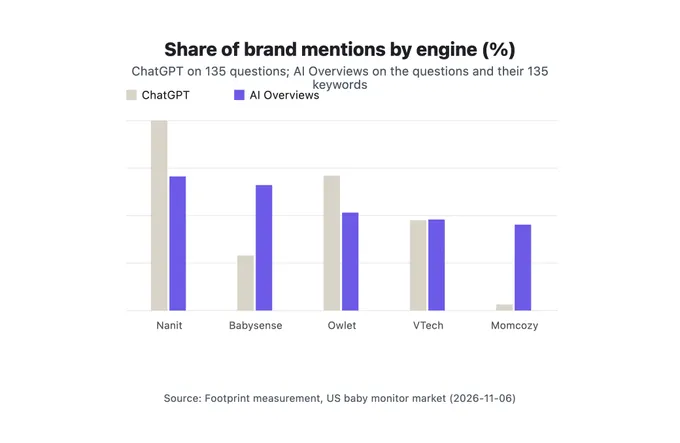
Google's AI Overviews put Babysense close behind Nanit, while ChatGPT ranked it far lower. Momcozy shows the sharpest split, with 10.0% of AI Overview mentions and 0.7% of ChatGPT's. The chart shows Babysense, the three brands ChatGPT named most and Momcozy. Not every brand splits this way: VTech sits at 10.5% and 10.6%, and Miku runs the other direction, with 9.0% of ChatGPT mentions and 3.3% of AI Overview mentions. Our Google AI Overviews case study covers that engine on its own.
Being named and being cited differ
ChatGPT linked a source in the passage for 107 of its 267 brand mentions, or 40%. The cited share varies widely by brand. Among the frequently named brands it ran from none of Angelcare's mentions to 79% of eufy's.
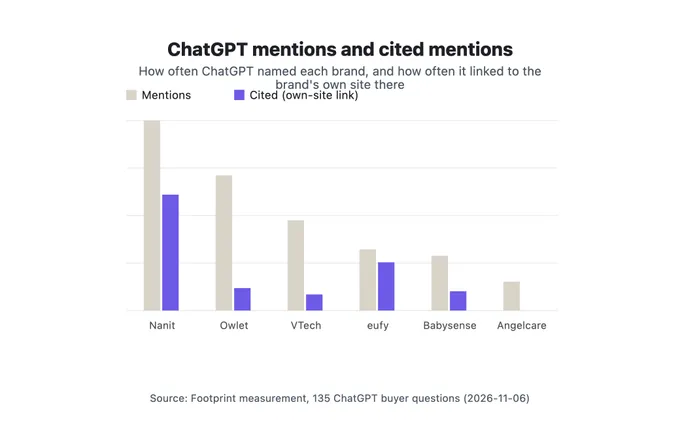
A cited mention suggests ChatGPT drew on the brand's site for that passage. An uncited one may come from what the model already knows, or from a third-party page. One possible reading of Owlet, which is named often with few links, is a brand the model knows well enough to name without searching.
What this data can't show
- One run. One day, one market, each question asked once. Counts move between runs.
- API, not app. Answers through the API can differ from what a person sees in the ChatGPT app.
- Different bases. ChatGPT answered 135 questions; the AI Overview counts cover the questions and their keywords.
- No cause. The correlations below describe 18 brands at one moment. Brand size is one possible common cause: a larger brand may simply attract more lists, videos and links.
- No result yet. No Footprint customer has a measured before-and-after result.
What a page needs before an engine cites it
Google and published research point to two requirements: the page can be found, and it answers the question first.
It can be found by the engine's search
A page the engine's search does not return cannot be cited. That is ordinary SEO: crawlable, indexed pages that are allowed a snippet. Google says that is all its AI features require technically, so a plan built mostly on new tags or files spends effort where Google says none is needed. For ChatGPT, check that your robots.txt allows OAI-SearchBot, and check the search crawlers of every other engine you care about.
It answers the question first
Put the answer in the first lines and give the engine something to quote: the product, the price, the numbers and the caveats. Research supports the second half of that advice. In the paper that named GEO, Aggarwal et al. rewrote web pages and found that adding quotations, statistics and source citations raised visibility in generated answers "by up to 40%" on their benchmark, while keyword stuffing gave little to no improvement (arXiv 2311.09735). That is a research-benchmark result, not a gain to expect from a live engine.
What tracked with ChatGPT's links to brand sites
For each tracked brand we counted 46 on-site and off-site activities, then checked how closely each one tracked the brand's own-site citation share. That share is a brand's cited mentions as a share of all brands' cited mentions on ChatGPT: Nanit has 36 of 107, or 33.6%. It is a different measure from the overall share of voice in the table above, so the correlation figures below are not comparable to the 22.1% column.
- Method. Spearman rank correlations across the 18 brands, reported from minus 100 to plus 100.
- Test. A permutation test against chance, with p below 0.05.
- Result. Sixteen of the 46 passed, against about two expected by chance. Many of these measure related activity, so they are not 16 separate findings.
The strongest were mentions on best-of lists that rank on Google (+71) and YouTube engagement on videos naming the brand (+70). Editorial mentions (+66), the number of YouTube videos naming the brand (+68) and Reddit upvotes (+64) were also near the top. You can see these signals in the Reddit and YouTube views.
Our scores for the brands' own pages did not pass. Content quality came out at −38 and readability at −36. In this market, outside attention tracked ChatGPT's links to a brand's site more closely than page quality did. These are leads worth testing, not proof that any activity raises citations.
How to start with answer engine optimization
- Write down buyer questions in the words buyers use, including the situation they describe. A smaller set works for a first pass; this measurement used 135 questions. We did not test how many are enough.
- Fix the set. Snapshots built on different questions cannot be compared.
- Record each engine separately, including Google AI Mode: every brand named, and whether the engine linked to that brand's own site beside it.
- Report share of voice with its basis, such as "17 of 267 mentions, 6 of 107 cited mentions". See AI share of voice for how it is calculated per engine.
- Write pages for the questions a competitor wins where you have no direct answer: one question each, answer first.
- Earn outside pages that say the same thing, such as a list placement, a Reddit reply or a creator video.
- Measure again. In our practice, a change that holds over two or three monthly runs is less likely to be noise, though it still does not show what caused it. Our guide on how to measure AI visibility covers the setup.
Frequently asked questions
AEO vs SEO: what is the difference?
SEO aims to rank a page in Google's list of links, and AEO aims to get a brand named in the answer an AI engine writes. They share a foundation, since answer engines find pages through search. See the AEO vs GEO vs SEO comparison.
Is AEO the same as GEO?
They overlap. As we use the terms, AEO is about being named in the direct answer to one question and leans on answer pages you publish, while GEO is the broader term for getting cited in AI-written answers, by editing your own content and by earning mentions elsewhere. Our what GEO is article explains the second.
Do I need special markup or an llms.txt file for AEO?
Google says no for its own AI features. Its guidance states that AI Overviews and AI Mode need no AI text files (see what is llms.txt) or special structured data, only a page that is indexed and eligible for a snippet. Other engines still need their own crawlers allowed: OpenAI, for example, says sites that block OAI-SearchBot will not appear in ChatGPT search answers.
Which answer engine optimization tools track whether AI engines name my brand?
Any tool or manual process works if it asks the same buyer questions on each engine you care about, records every brand named, and repeats monthly on the same set. ChatGPT and Google AI Overviews ranked the same baby monitor brands very differently, so track each engine separately. We did not measure Gemini, Claude or Perplexity in this run.
Babysense held the most page-one positions and ranked seventh in ChatGPT
In the Babysense data, the brand with the most page-one positions was still seventh in ChatGPT's answers, and 14.6% of Google AI Overview mentions against 6.4% of ChatGPT's suggests that, in this market, each engine needs its own measurement. In this market, best-of list mentions, YouTube engagement, editorial mentions and Reddit upvotes tracked ChatGPT's links to brand sites most closely. One plan worth testing pairs answer pages that rank with outside mentions, and measures both on each engine every month.
To see whether ChatGPT and Gemini name your brand today, run the free AI visibility checker, or book a demo to see your own numbers per engine. If you want help building the answer pages, see our answer engine optimization services.
Sources
Aggarwal et al., "GEO: Generative Engine Optimization", arXiv 2311.09735, accepted to KDD.
Footprint methodology. Measurement of ChatGPT with web search, Google page one and AI Overviews, US baby monitor market, 135 keywords and 135 buyer questions.