How to Rank in Google AI Overviews: 7 Steps
How to rank in AI overviews: what Google says it takes, seven steps to follow, and which page-one signals tracked brand links in our 243-overview study.


Updated November 11, 2026
In this article
What you'll need
What are Google AI Overviews and how do they pick links?
How to rank in Google AI Overviews: seven steps
Which activities did not track AI Overview links?
Show More
To rank in AI overviews, a page has to be indexed and eligible to show in Google Search with a snippet. Google says there are no additional requirements, no special markup and no AI text files. Beyond that, our measurement of 243 Google AI Overviews suggests the work extends well beyond your own site: most first-page results for a market's searches belong to other sites, and the query fan-out Google describes means those pages may be what the overviews read.
This guide gives seven steps, in order, with the numbers behind them. The examples come from Babysense, a baby monitor brand and Footprint customer that agreed to publish its data.
Key takeaways
- Google says a page needs only to be indexed and snippet-eligible to appear in AI Overviews. No schema.org markup or AI text file is required.
- Google builds each overview from several related searches ("query fan-out"), so a brand can be linked for searches it never targeted.
- In 270 US baby monitor searches, Google showed an AI Overview on 243 (90%). Babysense was named in 61 of them and its own site was linked in 12, the most of 18 brands.
- Across 18 brands, mentions on other sites' roundups, reviews and comparisons, YouTube engagement and the number of different sites naming a brand tracked how often its site was linked. These are leads to test, not proven causes.
- Page quality scores, word count and readability did not track links. Eighteen brands is a small sample, so that is a weak result, not proof they don't matter.
What you'll need
- A list of the 20 to 150 searches your buyers type, with their monthly search volume.
- About a day to check your searches (steps 1 to 3), then ongoing work on steps 4 to 7 and an hour a month to repeat the measurement.
- Difficulty: intermediate. You should be comfortable reading a Google results page and editing page templates.
What are Google AI Overviews and how do they pick links?
Google AI Overviews are the written answers Google shows above the regular results for some searches. They name products and brands, and they list source links next to the text. Our Google AI Overviews page covers how Footprint measures them.
"Rank" is a loose word here. An overview has no position one to win. A brand is either named in the text, linked in the sources, both or neither. This guide treats the two as separate goals: being named and being linked.
Query fan-out: one overview, many searches
Google's documentation says AI Overviews and AI Mode use "query fan-out," which it describes as "issuing multiple related searches across subtopics and data sources" to build a response. While it writes, the system finds more supporting pages, so it can display a wider and more diverse set of links than a classic search would. It adds that overviews appear only when its systems judge them to add value beyond classic Search (Google Search Central).
That has a practical effect. The searches that decide whether you are linked may be the related ones you never tracked, which is why step 4 below looks at your rankings across a whole topic.
How often an overview appears
We ran 270 US searches for the baby monitor market: 135 short keywords as typed and 135 longer questions built from them. Google showed an AI Overview on 243, or 90%. Longer questions triggered one more often than short keywords: 126 of 135 (93%) against 117 of 135 (87%). A different market, or a different day, will give different rates.
How to rank in Google AI Overviews: seven steps
Step 1: Confirm your pages are indexed and snippet-eligible
This is the only technical requirement Google names: the page "must be indexed and eligible to be shown in Google Search with a snippet." Google also warns that meeting every requirement does not guarantee crawling, indexing or serving.
Check these before anything else:
- In Search Console, run the URL Inspection tool on the pages you want used and confirm they are indexed.
- Look for a `noindex` tag or a `nosnippet` directive. Google lists `nosnippet`, `data-nosnippet`, `max-snippet` and `noindex` as the controls that limit what Search shows from your pages, and a page blocked from snippets is blocked from these features too.
- Check that `robots.txt` does not block Googlebot, which Google names as the control for crawl access.
- Make sure any structured data matches the visible text on the page.
If you added a control and content still shows, Google says recrawling can take several days to several months, so allow for that before you conclude it failed.
Step 2: Skip the special files
Google says "there's also no special schema.org structured data that you need to add" and that you don't need "new machine readable files, AI text files, or markup to appear in these features." An `llms.txt` file is one of those files. Our guide to what llms.txt is covers what it does for other tools. For Google's AI Overviews, time spent on it is time not spent on steps 4 to 7. The wider picture is in our AI SEO guide.
Step 3: Find which searches show an overview, and who is in them
Take your list of buyer searches (any keyword tool gives monthly search volume for each) and look at each one in Google. For every search, record whether an overview appears, which brands it names, which it links, and whether you are in either list. Do this for both the short keyword and the longer question behind it, because they can differ.
In the baby monitor market, Nanit was named in 73 of the 243 overviews (30%) and Babysense in 61 (25%). Babysense was named first in 33 of its 61.
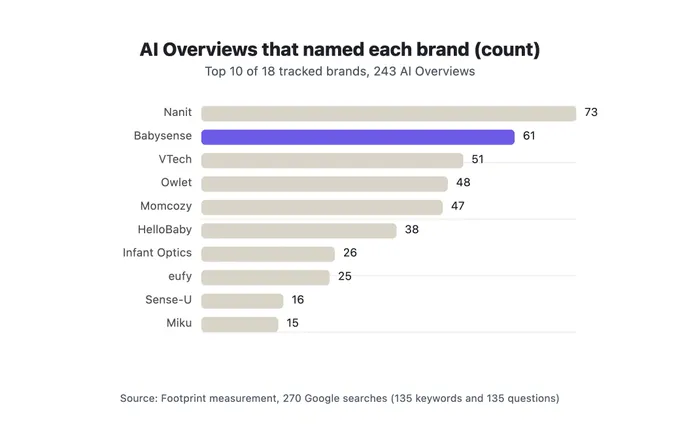
The same brand can look very different by search type. On the longer questions, Babysense came within two overviews of Nanit (34 against 36). On short keyword searches it fell to third, behind Nanit (37) and VTech (30).
Search volume changes the picture too. Weighted by monthly searches, Babysense's share of mentions falls from second to seventh, because one search, "best baby monitors," draws 110,000 searches a month, 60% of the 183,080 monthly searches we tracked. Google's overview for it names five rivals and leaves Babysense out. Find your own version of that search first.
Step 4: Rank your own pages for the whole topic
Because of query fan-out, the pages that earn a link are often the ones that rank for the related searches under a topic. Babysense's own site holds 38 of the 1,172 first-page results for the 135 keywords, more than any rival, and appears for 33 keywords. It ranks in the top three for 18 of them, the most in the market. Google linked its own site in 12 of the 243 overviews, twice Nanit's 6 and the most of the 18 brands. Of the 44 overviews that linked any tracked brand's site, Babysense had 12 (27%).
One possible reason is that Babysense's pages rank for many of the related searches an overview draws on. The data does not settle it:
- Momcozy holds 29 own-site first-page results, the second most, and was linked in only 4 overviews.
- Nanit ranks its own site on 5 keywords and was linked in 6.
- Across the 18 brands, how many keywords a brand's own site ranks for (+56 on a scale of -100 to +100) did not pass our significance test (p = 0.07), so it stays a lead at most.
So rank your pages, but don't expect ranking alone to produce a link. In this market it was not enough.
Step 5: Get named on the pages that already rank
This is the strongest result we have, and still a correlation. Of the 1,172 first-page results, 89.4% sit on sites none of the 18 brands owns. Store category pages (30.7%), review pages (21.6%) and blog posts (16.8%) make up most of page one. Brand home pages are 0.5%.
Other sites' first-page results mention VTech 343 times and Babysense 128. Blog, review and comparison results that name Babysense number 80, against 186 for Nanit. Babysense is named on 34 different other sites, VTech on 67 and Nanit on 66.
Across the 18 brands, blog, review and comparison results naming the brand scored +65, keywords where a brand appears anywhere on page one scored +65, and different websites on page one naming the brand scored +61. All three passed our significance test, though individual brands break the pattern: VTech is named on 67 other sites and was linked in 2 overviews.
To act on it:
- List the review and roundup pages that rank for your top searches. For the baby monitor keywords, page one held 253 review pages and 197 blog pages.
- Note which competitors each one names and which it leaves out.
- Pitch the author with something they can verify: a tested product, data, an expert quote or a discount code for readers. Our link building and digital PR service does this as a managed program.
- Count new placements each month in the same list.
Step 6: Show up on YouTube and Reddit
YouTube activity also tracked links. Likes and comments per month on new videos naming a brand scored +67, the highest of the five in the chart below. Babysense averaged 6.3 against 34 for Owlet. Reddit mentions scored +48 and passed, and forum and social mentions on Google's page one scored +52. Our YouTube marketing service works on the first of these.
A caution on Reddit: activity from the brand's own accounts scored +90, but it could be measured for only six of the 18 brands, so we don't rank it. Where you take part, do it openly as a person from the company.
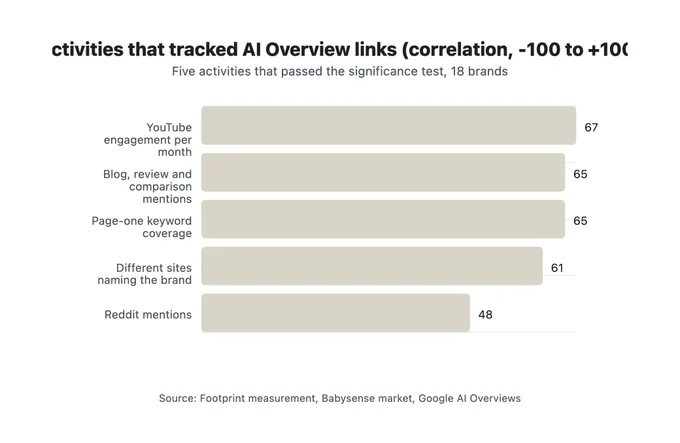
How we tested these: for each of the 18 brands we counted 46 activities and compared each against the brand's share of linked overviews with a Spearman rank correlation, which compares two rankings. A permutation test of up to 5,000 shuffles at p < 0.05 passed 18 of the 46, where chance alone would pass about two. Two signals that restate the target, such as a brand's own activity on Reddit (+69, +77), scored higher and are left out. Larger brands tend to do more of everything and also get named more, so these links may reflect brand size, not any one activity. Treat each as a lead worth testing in your market.
Step 7: Publish pages for the searches where you are missing
Once you know where an overview names rivals and skips you, give Google a page of yours to link. We picked six camera and breathing monitor searches where the keyword's overview named rivals and left Babysense out:
Search | Monthly searches | Brands the overview named | Babysense in the matching question's overview? |
|---|---|---|---|
best baby monitors | 110,000 | eufy, Nanit, Owlet, Infant Optics, VTech | No |
baby monitor camera | 8,100 | Nanit, eufy, VTech | Yes |
best baby monitors with camera | 1,300 | VTech, Motorola Nursery | No |
infant video monitors | 720 | Infant Optics, VTech, HelloBaby, Nanit, Owlet, Cubo Ai | Yes |
best baby breathing monitor | 480 | Owlet, Nanit | No |
best video baby monitor | 480 | eufy, Nanit, Infant Optics, VTech | Yes |
The six total 121,080 searches a month. Babysense is missing from the keyword overview in all six and from the question overview in three, so the camera gap is mostly a short-keyword gap. "Best baby monitors" is missing in both. These are examples of where to work first, not a ranking of every gap.
For each gap:
- Publish a page that answers the search directly, such as a page for "best baby breathing monitor" on the brand's own site.
- Add sourced statistics, named quotations and citations where they help a reader. We have not tested whether this earns a link from Google, so treat it as a starting point.
- Link the new page from the pages that already rank, so it can be found.
- Pitch the roundups from step 5 for the same search.
Which activities did not track AI Overview links?
Several things marketers expect to matter did not pass the test across 18 brands:
Activity | Correlation (-100 to +100) | Passed the test? |
|---|---|---|
Own-site keyword rankings | +56 | No |
Top-three keyword rankings of the brand's own site | +46 | No |
Average word count of the brand's pages | +41 | No |
New quality links per month | +24 | No |
Referring domains | +24 | No |
Content quality score of own pages | -2 | No |
Readability | -46 | No |
Treat a miss as a weak result, not a verdict. With 18 brands a real effect can fail to show, and each row is a single measure. What the table does say is that nothing on it was a shortcut: more words, more links and a higher quality score did not line up with more linked overviews here.
AI Overviews SEO: what stays the same and what changes
AI Overviews SEO builds on regular SEO, because Google only uses pages it has indexed. Our AEO, GEO and SEO comparison shows where the three differ. The difference is that the page you need to influence is often not yours.
| Classic SEO | AI Overviews |
|---|---|---|
What you win | A position for your page | A mention in the text, a link in the sources, or both |
Technical needs | Indexed, crawlable | Indexed and snippet-eligible, nothing extra |
Pages that matter | Your own | Yours and the review and roundup pages that rank |
How you measure it | Rankings and clicks | Share of overviews that name or link you, per search |
Clicks matter, so it is worth knowing what overviews do to them. Pew Research Center, studying browsing data from 900 US adults, found that people clicked a traditional result link on 8% of visits that showed an AI summary and on 15% of visits that did not. Clicks on links inside the summary happened on 1% of visits with one. Google says clicks from pages with AI Overviews tend to be higher quality and that this traffic appears in Search Console's Performance report under the "Web" search type. Neither figure is a measure of your own traffic, so check your own analytics.
Winning a place in the overview also matters on other engines. The same roundups and videos may feed the answers ChatGPT cites. On the same 135 questions, Google's overviews named Babysense in 34 (second to Nanit's 36), while ChatGPT ranked it seventh by share of mentions, so each engine needs its own measurement.
How to track AI Overviews with an AI Overviews tracker
An AI Overviews tracker repeats a fixed list of searches on a schedule and records whether an overview appeared, which brands it named and which sites it linked. A spreadsheet does the same for a dozen searches; a tracker saves the hours beyond that.
Each row records, for every search, whether an overview appeared, which brands it named and which sites it linked.
Whichever you use, hold these fixed:
- The search list. Changing it breaks the comparison with last month.
- The country. We measured from the United States only.
- The two forms of each search. Keep both the keyword and the question.
- The counts. Named, named first, and linked, per brand.
Run it monthly. Overviews change, and one day of searches is one sample. Footprint's guide to measuring AI visibility walks through the setup, and Footprint's AI Overviews tracker does this for every search on your list. If you would rather start free, try the free AI visibility checker.
Limits of this data
- One market, one day, one country. The figures cover 270 US baby monitor searches on one day. Overviews change.
- Eighteen brands. The correlations rest on a small sample and the signs and sizes can move between runs, as the own-site rankings result shows.
- Counts are a floor. A brand is named when the text names it, detected from the names and domains of the 18 tracked brands. Product names such as "Owlet Dream Sock" are not rolled up into their brand.
- No customer result yet. We have not measured a customer gaining overview links from following these steps. They are leads to test.
Frequently asked questions
How do I rank in AI overviews?
Make sure the page is indexed and eligible to show with a snippet, since Google says nothing more is required. Then work on the pages Google reads across the whole topic: rank your own, and get named on the review and roundup pages that already rank.
Do AI Overviews SEO and normal SEO need different markup?
No. Google says there is no special schema.org structured data to add and no new machine-readable or AI text files to create. Structured data you already use should match the visible text on the page.
How can I see which AI Overviews name my brand?
Search your list of buyer queries in Google and note whether an overview appears and which brands and links it shows. An AI Overviews tracker does this on a schedule. Search Console includes AI Overviews traffic in its Web performance data, but it will not tell you which overviews named a rival.
Do AI Overviews reduce clicks to my site?
Pew Research Center found people clicked a regular result on 8% of visits with an AI summary and 15% without. That compares different searches, so it does not show how many clicks one overview removes. Google says clicks from pages with AI Overviews tend to be higher quality. Measure both in your own analytics.
Most of page one belongs to other sites
The sharpest finding in our Google AI Overviews measurement is where the pages sit. Nearly nine in ten first-page results were on other sites, and we did not count which of them the overviews linked. The brand linked most often (Babysense, in 12 of 243 overviews) was also the one whose own pages ranked most widely. Ranking your own pages did not guarantee links, though: Momcozy had the second most own-site first-page results and was linked in 4. These are leads, and the way to learn which holds in your market is to measure it.
Start with step 3. To track the same searches each month across your market, book a demo.
Sources
Pew Research Center, "Google users are less likely to click on links when an AI summary appears in the results", browsing data from 900 US adults.
Footprint methodology. Babysense market measurement: 270 Google searches, 243 AI Overviews and 1,172 first-page results.